## What are married segments when redeeming miles?
Numerous airlines implement married segment principles for award tickets. This indicates that airlines may offer a varying number of award seats based on whether your travel includes a connection or not. This concept can be illustrated through an example.
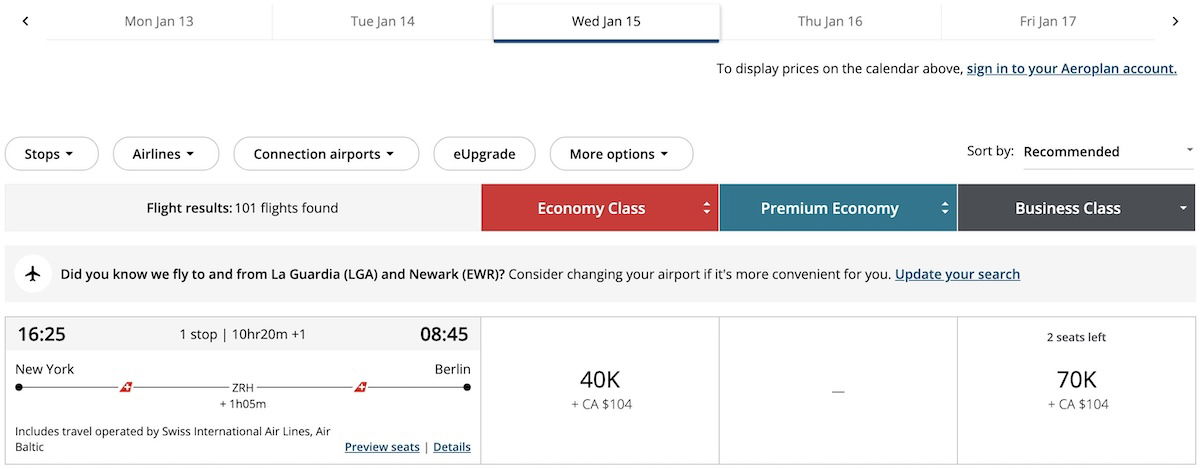
Consider the following scenario of attempting to redeem Air Canada Aeroplan points online. You can secure a business class award on SWISS flying from New York to Berlin via Zurich.
Award availability with married segment principles
Do you intend to reserve an award solely for that New York to Zurich flight, excluding the connection to Berlin? Unfortunately, it’s not accessible.
Award availability without married segment principles
As depicted, the airline only provides award seats for that New York to Zurich flight if it is “married” to another segment. This frequently occurs nowadays, as you may find no award availability while searching a direct route, but discover it when looking up a connecting journey.
Many airlines implement married segment principles for awards
## Why do airlines use married segment principles?
What drives an airline to offer award seats on a connecting journey, yet not when attempting to book just one segment? Airlines apply various strategies to optimize revenue and diminish the opportunity cost of permitting individuals to redeem points.
A significant number of consumers perceive airline pricing as illogical, in that the ticket price doesn’t mirror the operational costs of a flight. This boils down to airlines striving to maximize how much they can charge consumers depending on their travel behaviors.
In terms of married segment principles, the rationale is that airlines recognize consumers are willing to pay a premium for a nonstop flight. Typically, you will pay a higher price for a nonstop compared to one with a connection, as airlines understand that travelers value the convenience. This is the primary reason hidden city ticketing exists for flights.
The same reasoning applies with awards. Just as an airline could choose to charge more for a nonstop flight when paying cash, an airline might also opt to limit award seat availability to connecting flights rather than nonstop journeys.
Bear in mind that if you’re redeeming points for travel on a partner carrier, the limitations are enforced by the airline operating the flight, not by the frequent flyer program through which you’re making the booking. I find married segment principles to be prevalent on airlines like Cathay Pacific, Lufthansa, Qatar Airways, and many others.
Lufthansa employs married segment principles for awards
## Can you “divorce” flight segments?
If you encounter a situation where there’s award availability with married segments but not on one of the flights individually, is there a method to “divorce” those flights? Can you book an award encompassing both segments and then contact the airline to remove the unwanted segment?
The answer is nearly always no. Airline systems are quite sophisticated, and if an agent attempts to manually separate married segments, that flight will likely no longer appear as available, and an error message will occur if they try to remove just one segment.
Don’t anticipate airlines can “divorce” married segments
## Why should you care about married segment principles?
While it’s essential to recognize married segments (since it may clarify some oddities with award availability), why should you take note of it in practice? After all, the segments can’t be separated, so there isn’t really a method to utilize this to create your own award availability.
There are several factors regarding married segments as I observe them:
– Many individuals begin searching for award space by initially looking for availability on the long haul segment individually, then adding other segments; this might disadvantage you when married segment award availability exists.
– Although I wouldn’t advise this, some travelers will book a married segment itinerary and subsequently skip the last segment; be aware that this typically breaches the airline contract of carriage, and this won’t succeed if you need to check a bag, as that will be routed to your final destination.
– Many might presume it requires more miles to travel further, so you might be pleasantly surprised to discover that including a connection makes a flight more economical.
If you’ve ever attempted to redeem American AAdvantage miles for travel on American flights (instead of flights on partner airlines), you’ve likely witnessed how your origin and destination influence award pricing, similar to revenue tickets.
Looking to fly from Miami to Dallas to Billings? That’s bookable for merely 6,000 AAdvantage miles in economy or 16,000 AAdvantage miles in first class.
Award pricing for a connecting itinerary
If you wish to travel just that initial segment from Miami to Dallas? That will cost you 10,000 AAdvantage miles in economy or 29,500 AAdvantage miles in first class.
Award pricing for a nonstop itinerary
## Bottom line
Airlines regularly employ married segment principles for itineraries. In the