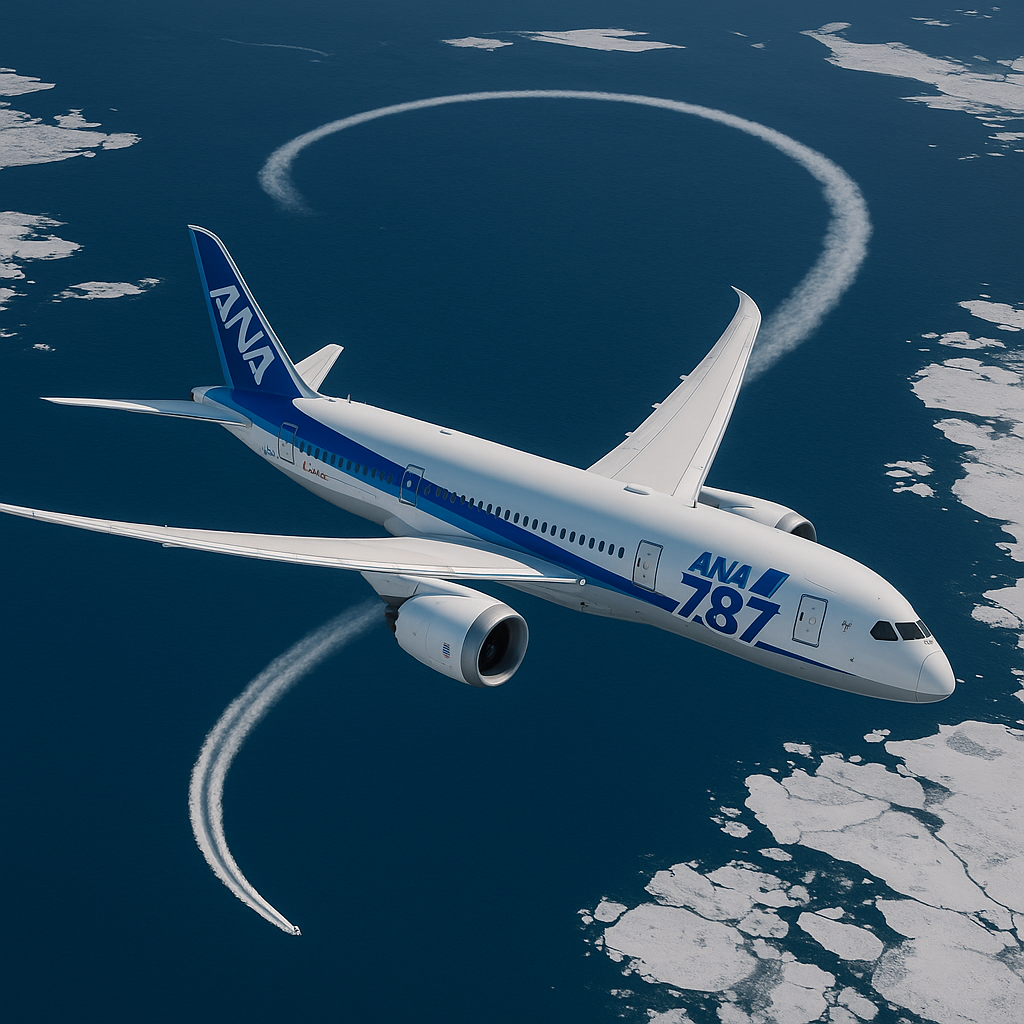
Not every flight proceeds as intended, and occasionally problems occur, requiring a diversion. From time to time we encounter a “flight to nowhere,” where a plane must make its way back to its starting point. Nevertheless, this must rank as one of the most extreme cases I’ve come across.
ANA 787 returns to its origin after 14 hours
This event took place on Tuesday, February 17, 2026, involving All Nippon Airways flight NH223, which was set to travel from Tokyo Haneda (HND) to Frankfurt (FRA). The flight was run by a decade-old Boeing 787-9 registered as JA875A, with 151 passengers and 13 crew members aboard.
This route typically requires about 13-14 hours, and the path isn’t always what one would expect. As ANA avoids Russian airspace, instead of heading westward, this flight actually heads eastward.
For instance, the usual flight trajectory for this ANA service from Tokyo to Frankfurt takes it out over the Pacific, passing over Alaska, the Arctic Ocean, and Greenland, before it reaches continental Europe.
On this specific day, the aircraft departed from Tokyo at 10:55 AM local time, merely 15 minutes behind the scheduled takeoff time. The flight proceeded as anticipated for a little more than six hours, having flown over Alaska, and then soaring over the Beaufort Sea (a part of the Arctic Ocean).
However, at this juncture, the crew opted to return to Tokyo due to a mechanical problem (more on that shortly). In the opposite direction, the winds were significantly stronger, making the return journey take approximately eight hours. Ultimately, the aircraft landed back in Tokyo at 12:59 AM this morning (Wednesday, February 18, 2026), 14hr4min after its departure.
This indicates that the flight actually took longer than average, but instead of passengers reaching their intended destination, they arrived back precisely where they began.
What caused this unusual ANA 787 diversion?
The reason behind the ANA Boeing 787’s diversion was said to be low oil levels in one of the engines. Now, you might be asking yourself, “if there’s an oil issue with the engine, how does it make sense to fly for another eight hours, rather than diverting sooner?”
After all, at the moment the aircraft turned back, it was a shorter flight to Frankfurt compared to Tokyo. I suspect this situation could be attributed to one of two factors (or a mix of both).
Firstly, right around the time the airplane reversed course, it was approaching a very isolated area, with minimal diversion options. While this was an ETOPS-equipped aircraft authorized to navigate this sort of route, that doesn’t imply that pilots would want to continue if there’s an existing concern.
On the other hand, they evidently didn’t classify this as an emergency; otherwise, they could have diverted to Alaska without much difficulty. While the logistics would have been challenging, my point is that if it had been necessary, it could have been achieved. Furthermore, the only other alternative would have involved diverting to Russia, which would also be less than desirable.
Secondly, frequently when airlines encounter maintenance challenges, they place a high priority on returning the aircraft to their home base. This approach enables the plane to be repaired most efficiently, and passengers can be accommodated on other flights more easily, etc.
While this was indeed a significant inconvenience for the passengers, it’s far from unusual to witness this type of response.
Conclusion
An All Nippon Airways Boeing 787 traveling from Tokyo to Frankfurt turned back at approximately the midpoint, due to a low oil level issue in one of the engines. Ultimately, the aircraft