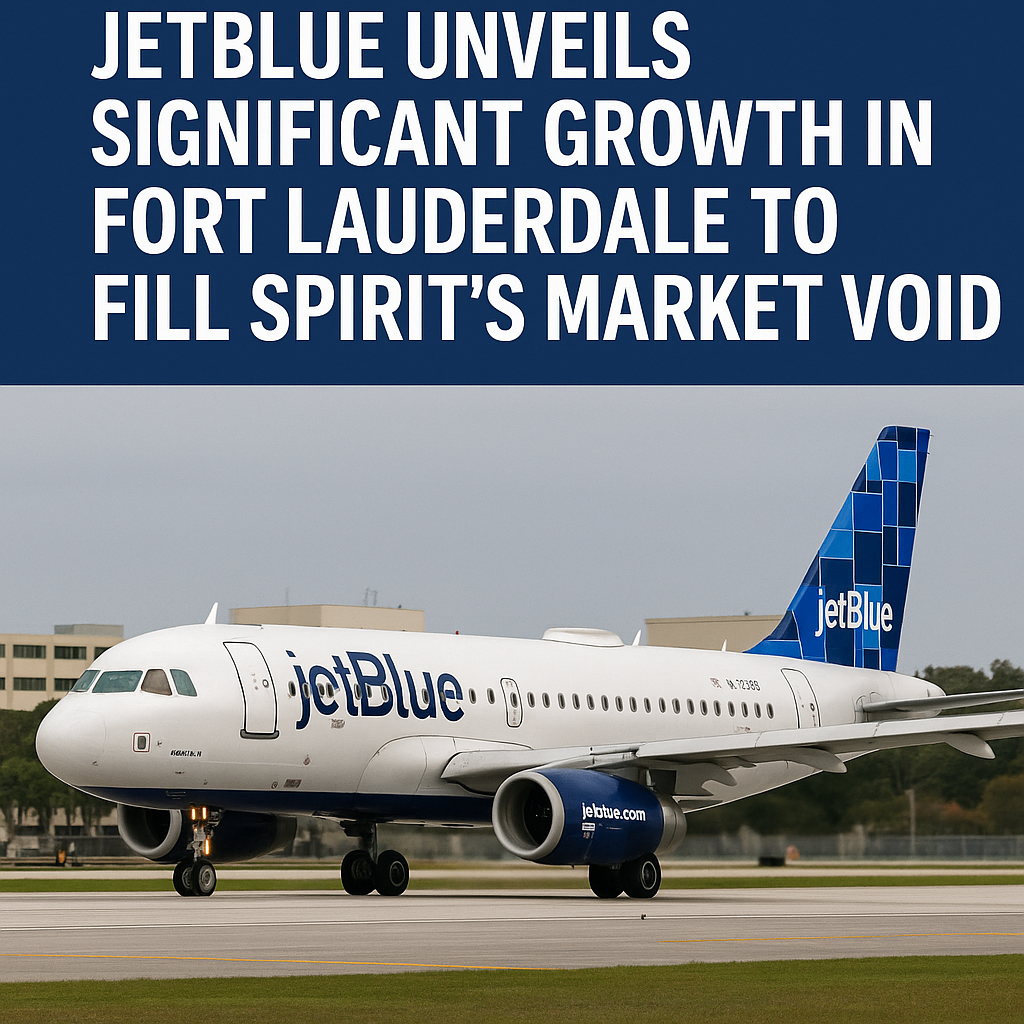
We observed Spirit Airlines halt operations early this morning, following seven consecutive years of financial losses and filing for Chapter 11 bankruptcy on two occasions. It’s evident that Spirit’s closure brings a sense of relief to several other airlines in the country that are currently struggling, such as Frontier and JetBlue.
In light of this, JetBlue is promptly modifying its route network to capitalize on the gap left by Spirit, aiming to enhance its own financial situation.
JetBlue’s crew base adjustments provide insight into its strategy.
JonNYC shares how JetBlue has informed its internal teams about plans to adjust its flight attendant bases mere hours after Spirit’s operations ceased. As described by the airline, it is taking action to align staffing more closely with actual flying activities.
Consequently, the airline is wisely assigning newly hired flight attendants to the bases experiencing the highest demand. The airline is also investigating methods to voluntarily prompt flight attendants to relocate between bases. While not completely dismissing the possibility of forced base relocations, that option will only be considered once all other avenues are explored.
JetBlue hasn’t been experiencing significant growth lately, so any new flying will likely come at the cost of current operations. This is why JetBlue’s proposed base adjustments are particularly noteworthy.
JetBlue identifies three undersupplied bases:
– It aims to increase its Fort Lauderdale (FLL) base by 100%, which currently has 682 flight attendants.
– It seeks to upsize its San Juan (SJU) base by 100%, which currently has 228 flight attendants.
– It plans to expand its Boston (BOS) base by 10%, which currently has 1,245 flight attendants.
Conversely, JetBlue has four overly staffed bases:
– It intends to reduce its Orlando (MCO) base by 30%, which currently houses 1,106 flight attendants.
– It wants to decrease its Newark (EWR) base by 30%, which currently has 292 flight attendants.
– It aims to shrink its Los Angeles (LAX) base by 30%, which currently consists of 265 flight attendants.
– It plans to cut its New York (JFK) base by 10%, which currently employs 2,748 flight attendants.
It’s important to note that the size of crew bases does not necessarily correlate directly with the volume of flights that will occur. Over time, bases can oscillate between being overstaffed and understaffed, and other factors influence the determination of crew bases beyond the number of nonstop flights originating from a particular airport.
How will the competitive landscape evolve in Fort Lauderdale?
Fort Lauderdale was the primary base for Spirit, making it the airport to closely monitor in the upcoming days and weeks. Here’s a rough estimation of the market share at the airport in 2025:
– Spirit held approximately 30% market share.
– JetBlue captured around 20% market share.
– Delta accounted for roughly 15% market share.
– Southwest secured about 12% market share.
– United comprised around 9% market share.
It has been many years since we’ve seen an airline in the United States liquidate in such a swift manner, so I’m intrigued to see how this scenario unfolds in Fort Lauderdale. The airport operates without slot controls, so the focus is on gate availability.
Will gates be temporarily assigned to any airline willing to introduce service there, or what does the long-term gate allocation process look like in this context? Do airlines need to submit proposals, after which the airport makes a decision?
From my perspective, two airlines are likely the most interested in significant expansion at Fort Lauderdale:
– JetBlue stands to benefit greatly in Fort Lauderdale, considering its other two hubs are in second place behind Delta, so becoming the top airline at a prominent airport would be advantageous (though it didn’t do Spirit any favors, given its current situation).
– United has long shown interest in establishing a hub in Florida, and this appears to be an optimal opportunity to acquire numerous gates simultaneously; I imagine United CEO Scott Kirby would be quite pleased to set up a base so close to American, given his negative view of that airline (although South Florida is a market where United will likely remain in second place).
– We are aware that JetBlue and United have a partnership, and there have been longstanding rumors regarding potential consolidation, so when considering the combined presence of JetBlue and Spirit at the airport, we observe around a 50% market share, which presents a considerable foundation to build upon in a short timespan.
Naturally, some may argue, “Spirit was losing money, so why would anyone want to expand there so much?” However, with Spirit’s exit, airlines will have greater pricing power in that market, without having to