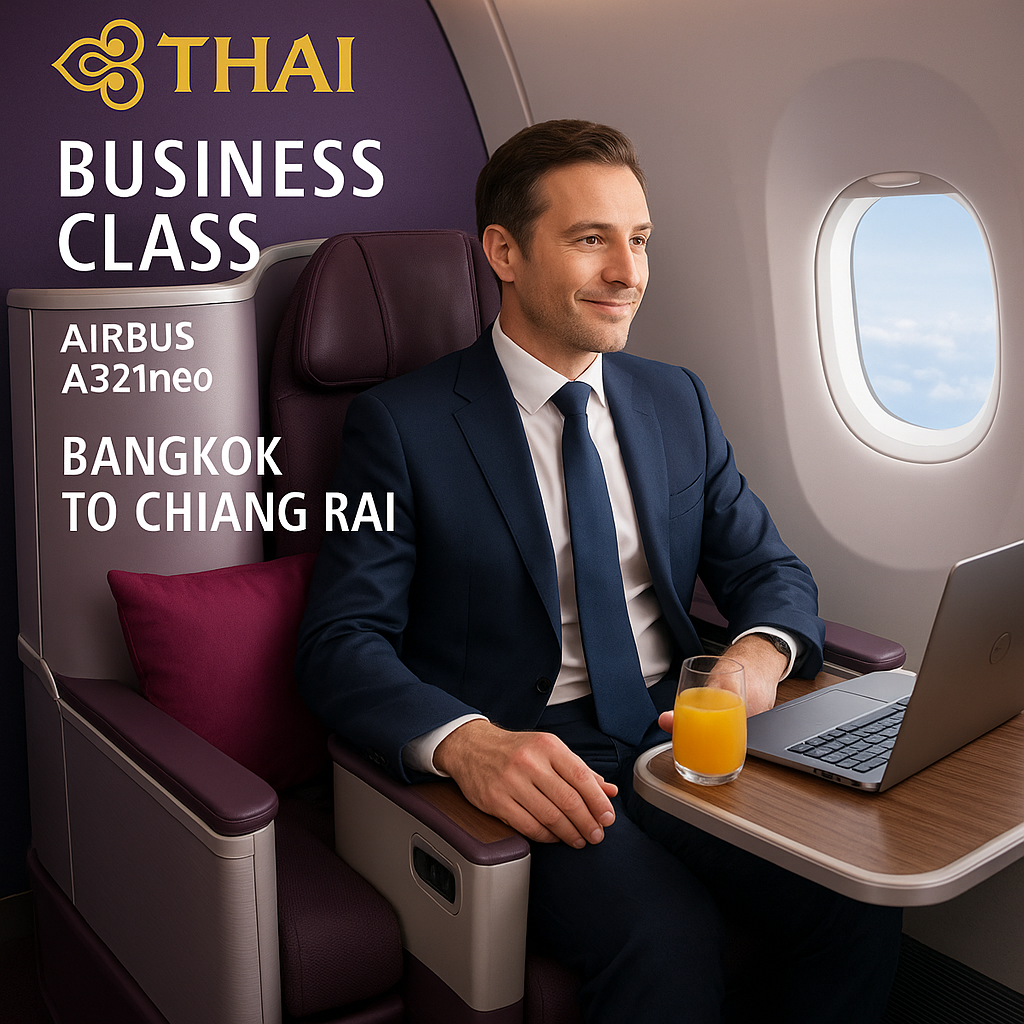
For the upcoming segment of my dual-part birthday journey to the Golden Triangle, we took a flight with Thai Airways in business class aboard their Airbus A321neo on the 65-minute route from Bangkok (BKK) to Chiang Rai (CEI).
I was eager for this flight since the A321neo represents Thai Airways’ latest aircraft, featuring flat beds in business class. Although I anticipated that the service would be limited due to it being a domestic flight, I was still looking forward to experiencing this product.
Overall, I found the domestic business class experience with Thai Airways to be excellent and reasonably priced. While it may not be extravagant, the seats were comfortable, the service was pleasant, and the food was quite decent.
How I secured my Thai Airways business class ticket
We purchased our return flights between Bangkok and Chiang Rai with cash, as the prices were fair, and no award seats were available. Specifically, we booked the following in business class for $330.24 per person roundtrip (which was roughly $50 more each way than economy, at the time of booking):
4/21 TG132 Bangkok to Chiang Rai departing at 11:35AM and arriving at 1:10PM
4/25 TG131 Chiang Rai to Bangkok departing at 10:10AM and arriving at 11:40AM
The outbound flight was operated by the A321neo, while the return was on the A320, allowing me to compare the two experiences.
Thai Airways business class lounge & boarding
We arrived at Bangkok Suvarnabhumi Airport around 10AM for our 11:35AM departure. We quickly located the domestic check-in area, where there was no line for business class.
Next, we proceeded to Thai Airways’ domestic lounge, situated in Concourse A, close to gate A1. I won’t provide a full review of the lounge since we only briefly visited. I would characterize the lounge as basic yet adequate, and it wasn’t overcrowded, which was nice. It offered a modest variety of hot and cold food, along with non-alcoholic beverages.
Our flight was set to depart from gate B4, with boarding scheduled for 11:05AM, 30 minutes before takeoff. It was a short walk to Concourse B, where we also cleared security — there was no line whatsoever.
At the gate, we spotted the A321neo with the registration HS-TOA, which is essentially brand new (apologies for the poor photo quality, as Bangkok Airport has windows that are hard to photograph through).
Boarding was delayed by approximately 15 minutes due to preparations in the cabin. It eventually commenced at 11:20AM, with business class passengers and those requiring extra time invited to board first.
Thai Airways A321neo business class cabin & seats
Upon entering through the forward door, we were welcomed by two cordial flight attendants before entering the business class cabin. Thai Airways’ Airbus A321neo business class features 16 seats, distributed across five rows.
This layout is staggered based on the Thompson Aero Vantage platform, causing rows to alternate between a 2-2 and a 1-1 configuration. This is a fairly standard staggered arrangement, akin to what some A321-family aircraft operated by Aer Lingus, JetBlue, Scandinavian Airlines, and TAP Air Portugal employ.
One notable aspect of the cabin design is how Thai Airways has reduced the prevalence of purple tones in its newest aircraft — I believe this design strikes a nice balance, incorporating some purple while avoiding excessive use.
In this setup, you’ll find three rows with pairs of seats, which are likely better for those traveling together; however, keep in mind that due to the console between seats, you must lean forward to converse with the person next to you.
Additionally, there are four individual throne seats. The purpose of this configuration is that the footwell is adjacent to the seat in front, which explains the staggered arrangement. These seats are preferred for providing direct aisle access and a window view.
Each seat has a small vertical storage area beside it, along with reading lights, USB-A and USB-C charging ports, and universal power outlets (the only tech feature missing is wireless charging).
In this configuration, the tray tables slide out from the side of the seat, where they are stowed vertically. While stored, they fold in half, requiring you to flip the table over to fully extend it.
These throne seats offer substantial space on both sides, as the window-side armrest serves as a large storage area where you can place items like a laptop during the flight.
Seat functions can be adjusted via a straightforward panel located to the side.