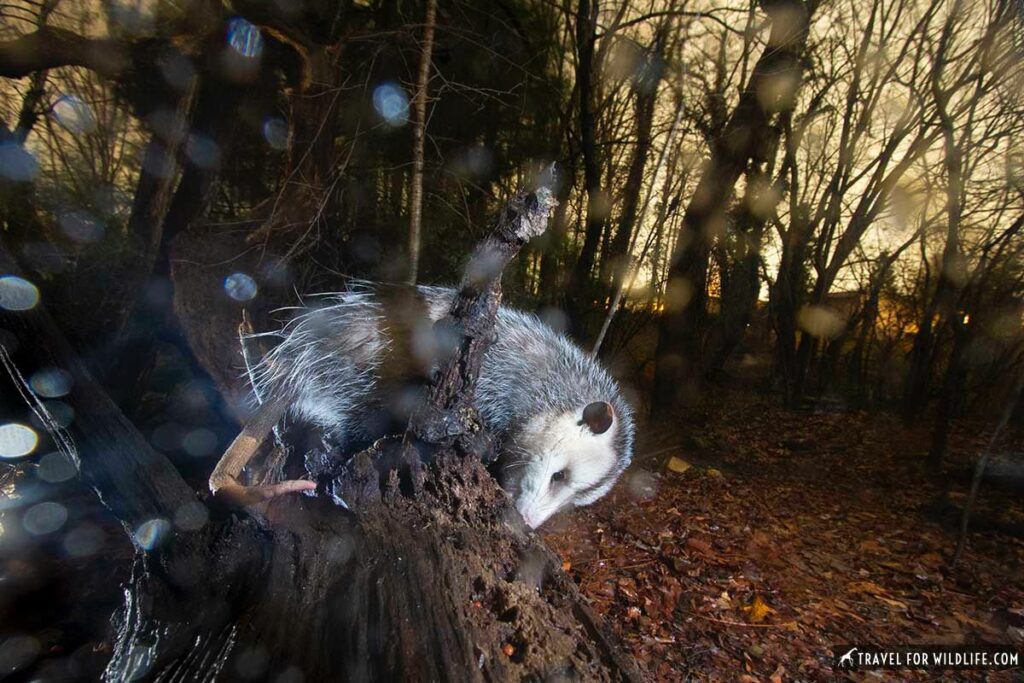
Virginia opossums (Didelphis virginiana) represent the sole marsupials in the United States, and we take pride in coexisting with them in our yard. As they are nocturnal, we rarely witness them directly, but our camera traps confirm their presence. Recently, we filmed a fascinating opossum behavior: the use of its tail. Watch the video below to see the opossum tail in action!
The opossum tail serves to transport nesting materials
Opossums utilize their prehensile tails to transport nesting materials (leaves, twigs, corn husks…) back to their dens. This is their method: opossums gather leaves with their mouths and then transfer them to their front feet, followed by their back feet. They wrap their tail around the bundle of leaves, carrying this bedding with their semi-prehensile tails as though it were a fifth limb!
We have recorded this behavior several times on our trail cameras. The recent video below shows an opossum collecting leaves and bringing them to his den, located just about 10 feet from our home. We intentionally leave our leaves on the ground during the fall so that opossums, woodchucks, and squirrels can use them for their nests. Opossums do not create their own dens; instead, our neighbor is making use of a woodchuck burrow. Leaves are utilized to line the den, improving insulation during the cold winter months.
Opossum tails assist in balancing while climbing trees
While juvenile opossums can hang from their tails (if prompted), adult opossums are too heavy and do not use their tails for such purposes. However, they do utilize them for balance and stabilization on branches when ascending trees.
Opossum tails are not handles
Lifting a fully grown opossum by the tip of its tail can cause significant injury by dislocating its tail bones.
To discover more about opossums, check out our article Possum vs Opossum: What’s the Difference?