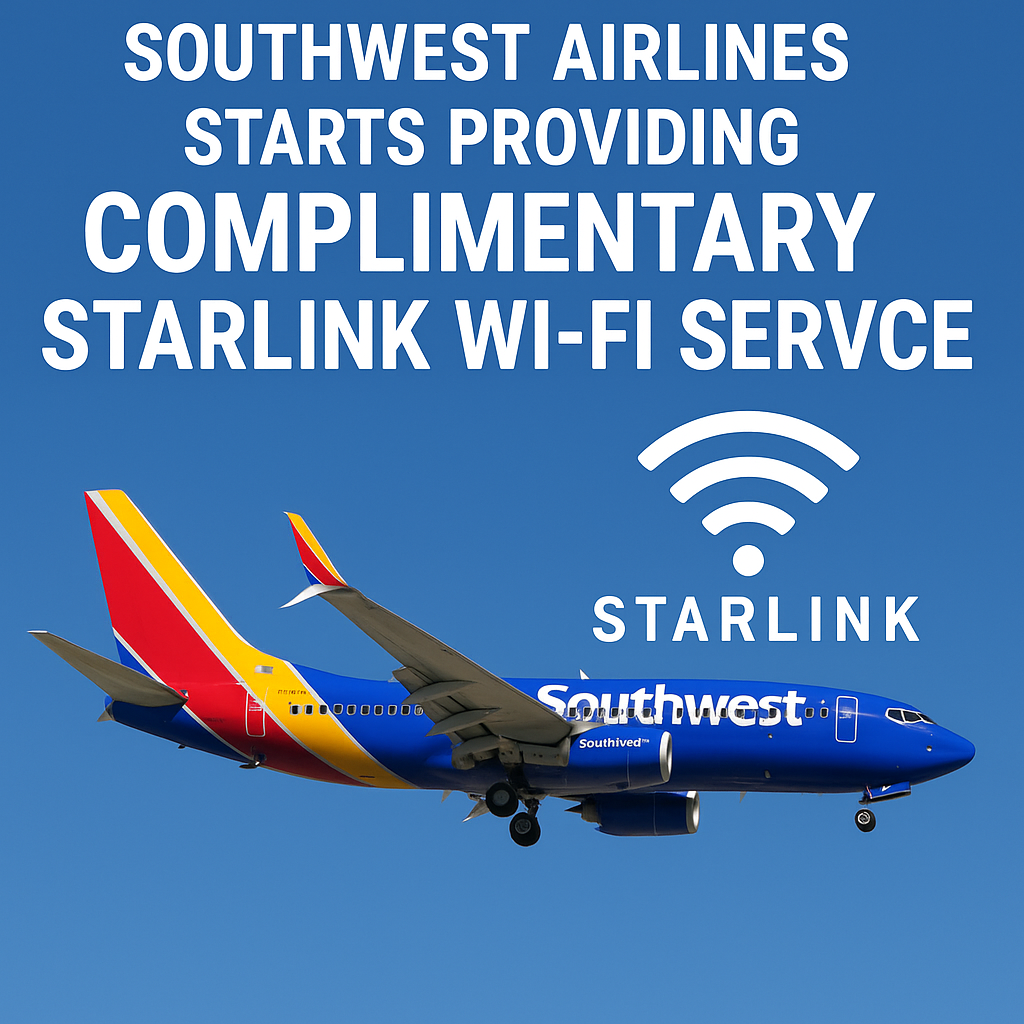
In February 2026, Southwest Airlines unveiled plans to provide complimentary Starlink Wi-Fi for Rapid Rewards members, representing a major improvement in passenger experience. The initial aircraft outfitted with this service is now in service, and a rapid expansion is forecasted, with over 300 aircraft expected to feature Starlink by year-end.
Southwest is partnering with SpaceX to deploy Starlink Wi-Fi throughout its Boeing 737 fleet. The inaugural plane, registered as N8543Z, is already delivering this service to travelers. The ambition is to install Starlink on more than 300 Boeing 737s by the close of 2026, with projections indicating that nearly all aircraft will offer the service by the conclusion of 2027. Southwest’s fleet includes over 800 737s, with an additional 500+ on order.
Starlink provides high-speed, low-latency broadband internet available from gate to gate. The Wi-Fi accommodates live streaming, productivity similar to ground-level internet, gaming, e-commerce, and multiple devices. Passengers have claimed that Starlink Wi-Fi represents a revolutionary experience.
Tony Roach, Southwest Airlines’ Chief Customer & Brand Officer, remarked, “Starlink ushers in a new age of inflight connectivity for Southwest. Beginning with this first aircraft, we will be swiftly incorporating Starlink into our fleet this year. This ultra-fast Wi-Fi brings a home-like experience onboard and transforms how Customers can remain connected, be productive, and optimize their time while traveling at 35,000 feet.”
This advancement is thrilling for Southwest, which has made significant headway in enhancing inflight connectivity. In October 2025, Southwest rolled out free Wi-Fi for all Rapid Rewards members, in line with JetBlue, Delta, and American. Nevertheless, Southwest’s current Wi-Fi systems are antiquated, with Viasat available on a mere handful of aircraft. The transition to Starlink signifies a substantial upgrade in passenger experience, presenting much improved connectivity.
Recently, Southwest has made considerable changes, revamping its business model by retiring open seating, launching basic economy fares, imposing charges for checked bags, and introducing extra legroom economy. The inclusion of swift and complimentary inflight connectivity is a welcomed advancement, as passengers increasingly anticipate high-speed Wi-Fi.
Among the “big four” US carriers, United is at the forefront of next-generation Wi-Fi deployment, with Starlink operational on over 400 planes and ambitions for 1,000 by the end of 2026. Southwest is in pursuit, aiming for 300+ planes by the close of 2026 and the entire fleet by the end of 2027. American intends to bring Starlink to 500 planes by early 2027, while Delta plans to roll out Amazon Leo Wi-Fi on 500 planes by 2028.
In conclusion, Southwest Airlines has commenced the provision of free Starlink Wi-Fi, with the first Boeing 737 already operational. The objective is to equip 300+ planes with Starlink by year’s end, greatly enhancing inflight connectivity for travelers. This progress is especially advantageous considering Southwest’s prior Wi-Fi constraints.