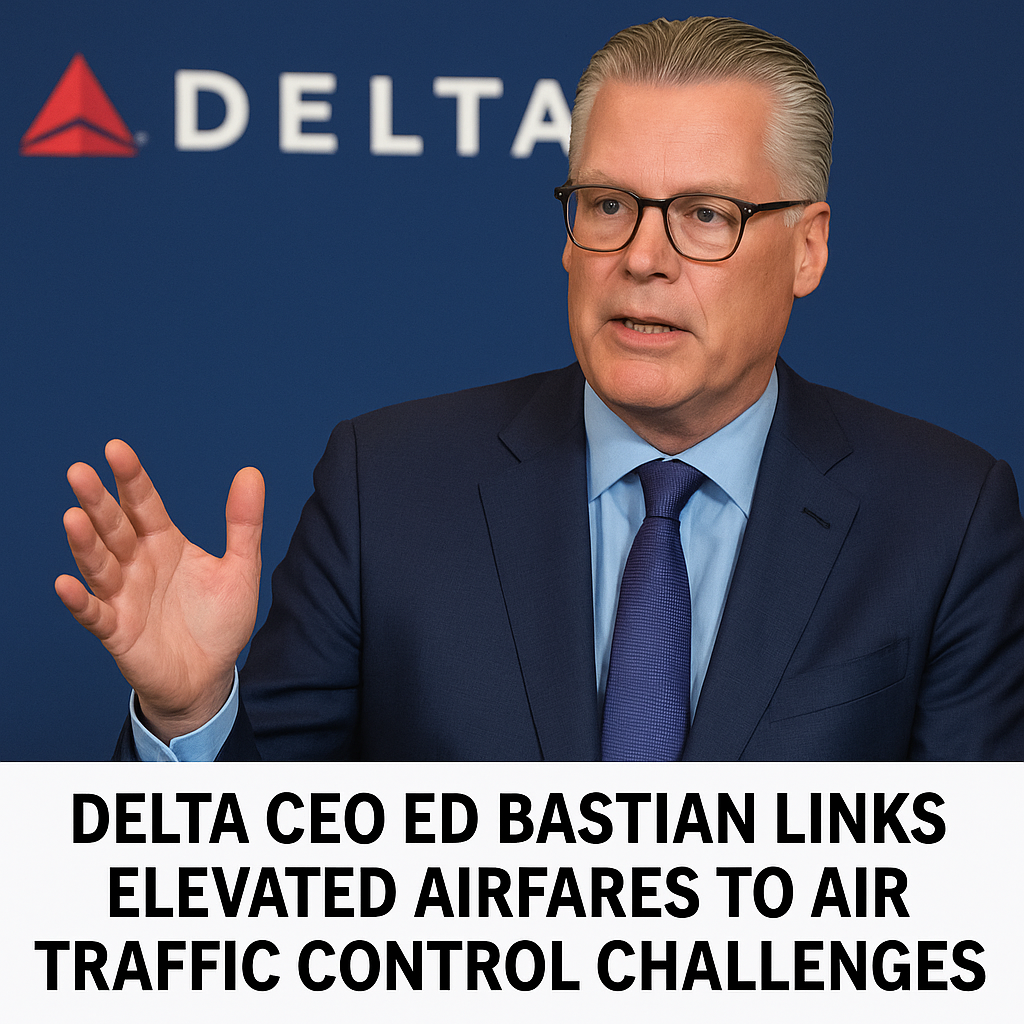
**Delta CEO Attributes Elevated Fares to ATC Capacity Limitations**
Delta’s CEO Ed Bastian recently engaged in an interview with Maria Bartiromo on Fox Business, where he addressed multiple issues concerning the airline sector. During the discussion, Bastian linked the high airfares to capacity limitations stemming from the overcrowded air traffic control (ATC) system. He proposed that overhauling the ATC system may assist in lowering airfare by boosting the flight supply.
Bastian’s remarks have ignited discussions, as many contend that the elevated prices are not exclusively due to ATC problems. Although reforming the U.S. air traffic control system is essential for enhancing efficiency and minimizing delays, the assertion that it is the main cause of high airfare is viewed as an oversimplification.
**Capacity Cuts and Airline Tactics**
The rise in airfare is more accurately ascribed to airlines deliberately cutting capacity to elevate prices. Airlines have willingly reduced the frequency of flights, resulting in increased fares. This approach is driven by the fundamental economic principle of supply and demand, where diminished supply results in higher prices.
Additionally, airlines have been utilizing smaller regional jets with a reduced number of seats, contributing to airspace congestion. For instance, Delta has made orders for smaller mainline jets such as the A220, which possess fewer seats relative to larger aircraft.
**Airfare Trends and Industry Expenses**
Airfare has surged by roughly 30% since the start of the year, a number significantly exceeding the 10-15% increase cited by Bastian. This escalation is not attributed to modifications in the ATC system but rather to the airlines’ tactical choices to restrict capacity.
Even prior to the recent fare increases, the passenger revenue per air seat mile was frequently less than the cost per air seat mile for U.S. airlines. This discrepancy was compensated for by loyalty programs and alternative revenue sources. With escalating industry costs, it is improbable that the gap will widen further without substantial shifts.
**Diverging Perspectives on Airfare Pricing**
United’s CEO Scott Kirby has candidly pointed out that elevated airfare is likely to continue, particularly if the ongoing geopolitical conflicts persist. Kirby’s forthright recognition of the scenario contrasts with Bastian’s suggestion that ATC reform could markedly reduce fares.
**Conclusion**
While revising the air traffic control system is crucial for enhancing air travel efficiency, it is not a cure-all for high airfare. The recent price surge is mainly due to airlines’ strategic capacity reductions. A more straightforward rationale for potential future fare decreases would hinge on the resolution of current geopolitical tensions, rather than exclusively depending on ATC enhancements.