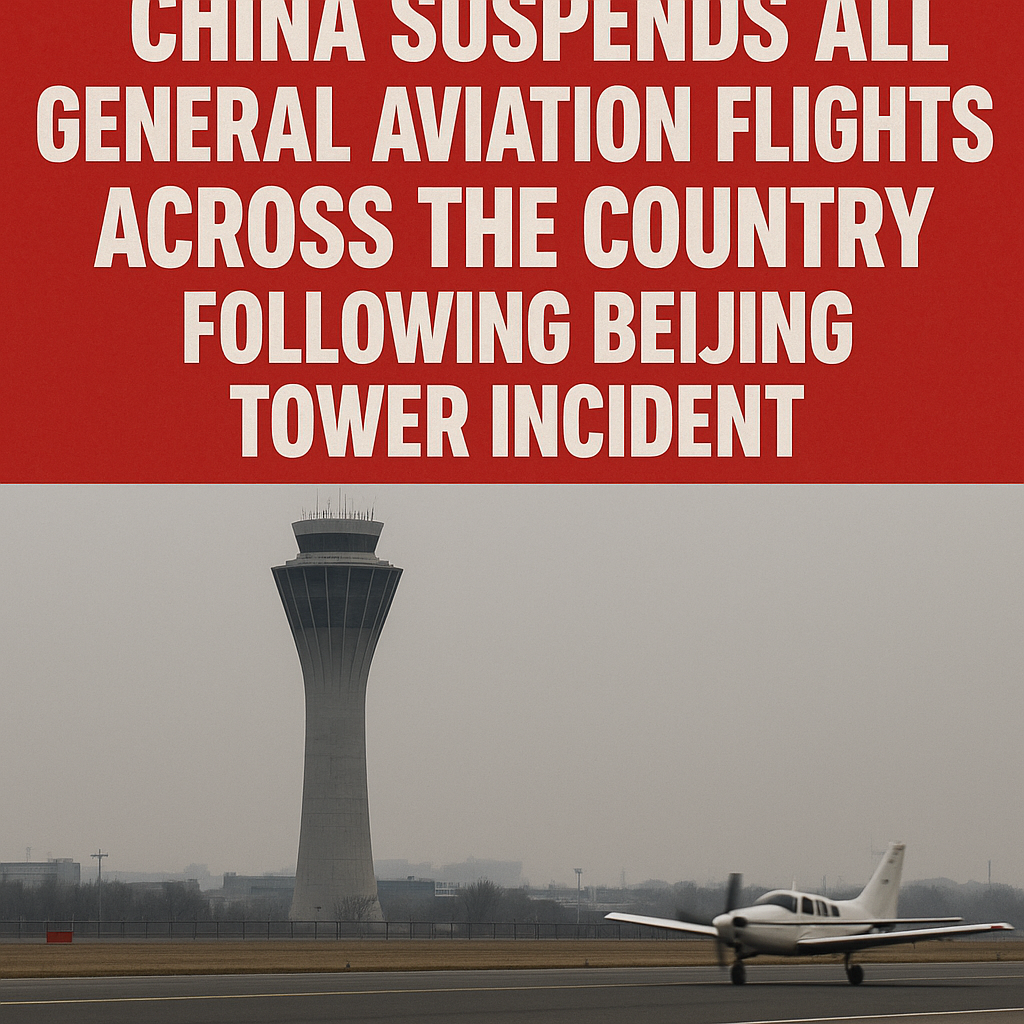
Reports indicate that China has recently imposed an indefinite ban on nearly all general aviation activities across the nation. If this persists for any considerable duration, it marks one of the most severe actions taken by any country to limit general aviation operations.
In this post:
China indefinitely halts general aviation activities nationwide
On June 26, 2026, a tragic incident occurred in Beijing when a light aircraft collided with the city’s tallest tower, resulting in the pilot’s death and injuries to several individuals. While information regarding the incident is sparse, it is evident that this was a deliberate act, as suggested by the aircraft’s trajectory, unauthorized entry into restricted airspace, and failure to communicate with air traffic control.
As anticipated, this has led to increased security measures not just in Beijing, but across the entire nation. Nevertheless, the severity of the restrictions we are witnessing is quite remarkable. The Financial Times has reported that China has grounded all non-essential light aircraft indefinitely.
This includes private light fixed-wing flights, corporate jets, leisure flying, and flight training. Consequently, only commercial and emergency aircraft are permitted to fly. Even flight training schools have been forced to cease their operations while authorities in Beijing determine the best approach to manage the situation.
This situation will be challenging for the Chinese government to navigate
It appears that officials in Beijing are apprehensive about the potential for a similar incident and are in search of the most effective way to respond. In recent years, China has significantly expanded its low-altitude flying industry, including the use of drones, which undoubtedly carries its own set of hazards.
The crash at the tower has revealed vulnerabilities in the government’s air defense system. Before the aircraft struck the tower, air traffic controllers attempted to reach the pilot but received no reply.
The military dispatched helicopters to intercept the plane but failed to arrive in time. Even had they intervened, downing a small aircraft in a densely populated region might not have yielded a better result concerning damage, casualties, and public perception.
Officials are reportedly considering mandatory mental health assessments for aspiring pilots, as well as new certification requirements for flight training institutions.
It should also be noted that in March 2022, a China Eastern Boeing 737 experienced a crash — investigations revealed that both engines had been turned off, leading international authorities to suggest it was a pilot suicide. However, China has declined to disclose the reasons behind the accident, claiming that “disclosure may endanger national security and social stability.”
Mental health is certainly a global concern, yet fostering a culture that prioritizes secrecy and denial complicates matters further.
Bottom line
China has allegedly suspended a significant portion of general aviation operations following Friday’s event, where a light aircraft crashed into Beijing’s tallest tower. This triggered widespread alarm throughout the country, given its almost certain intent.
Halting general aviation in a nation with 1.4 billion residents is a significant action. For now, we classify this as “developing,” as I am eager to see how the country proceeds. This represents a substantial obstacle for the broader aviation landscape in the nation.
What are your thoughts on how this general aviation ban in China will unfold?