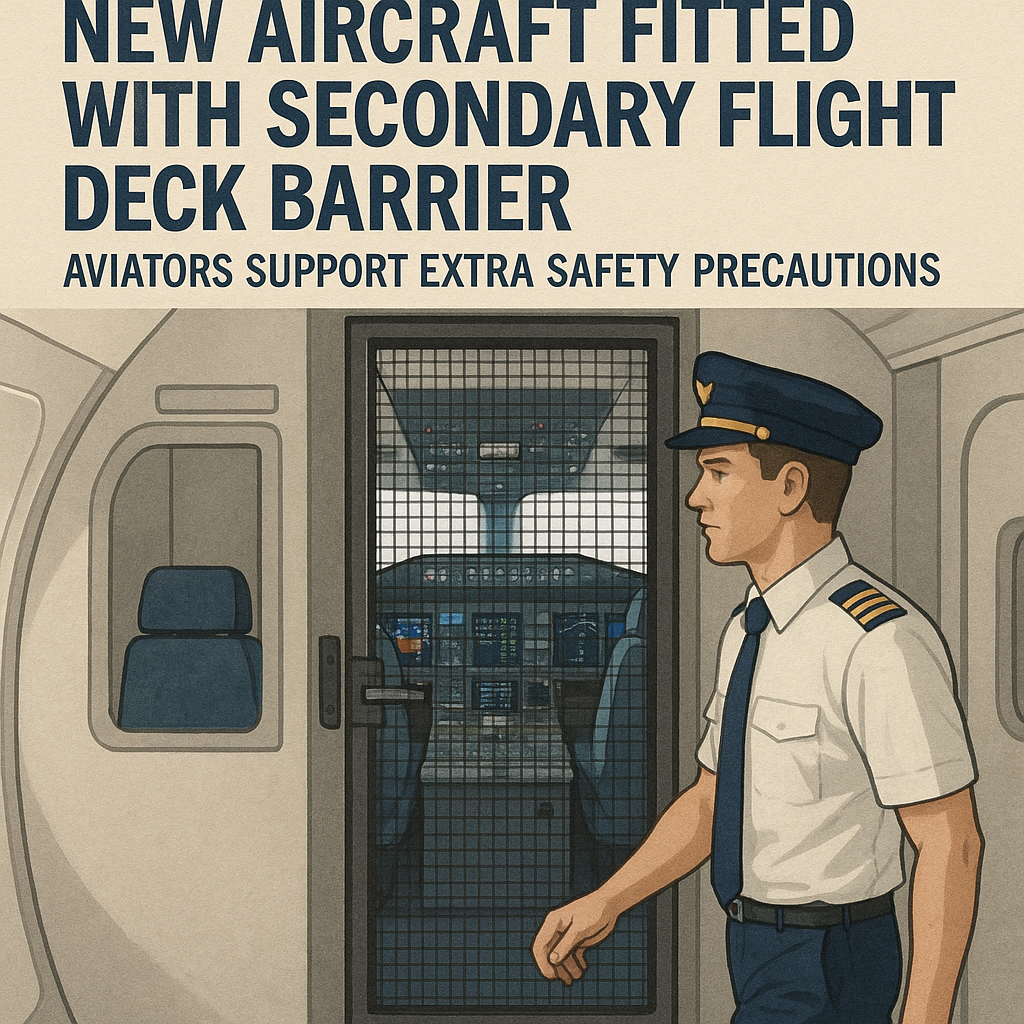
For years, discussions have revolved around the possibility of introducing a second flight deck barrier in commercial aircraft across the United States. This notion gained traction in 2022 when regulators advanced a recommendation to put this modification into effect. The signing of the FAA reauthorization bill in 2024 formalized this initiative.
As airlines begin to receive aircraft equipped with the new secondary barrier, this policy has officially taken effect — starting August 25, 2026, all new commercial aircraft delivered in the United States must include this feature.
FAA mandates secondary flight deck barrier on new aircraft
The Federal Aviation Administration (FAA) has established a regulation that necessitates a secondary barrier on the flight deck of new Part 121 commercial airplanes in the United States, aimed at safeguarding the aircraft, crew, and passengers. According to the FAA, the goal is to delay any potential assault on the flight deck sufficiently to secure and lock it before an assailant can reach it.
Consequently, aircraft manufacturers must incorporate a second barrier on all planes delivered from August 25, 2026. Nevertheless, there are no initiatives to retrofit existing aircraft with this feature.
This idea was proposed many years ago — the FAA was expected to finalize this regulation by 2019 following a 2018 federal law, but action was delayed until recently. The terrorist incidents of 9/11 have undoubtedly reshaped aviation. Since then, we’ve witnessed the implementation of reinforced flight deck doors, which are virtually impossible to breach.
The purpose of this new legislation is to address scenarios where one of the pilots must vacate the flight deck (for reasons such as restroom breaks, etc.). In the past, a flight attendant would merely block the aisle with a cart while the door remained ajar during those instances.
The FAA estimates the cost of this secondary barrier at $35,000 per aircraft, covering both the barrier’s purchase and installation. Once training and additional costs are factored in, the present value expenses for this regulation sit at $236.5 million at a 7% discount rate and $505 million at a 3% discount rate.
For those interested in how this works, check out the video below demonstrating this mechanism in action on a Southwest Boeing 737 MAX. Essentially, it’s a folding door that can be stored during most flight phases and easily extended when required, functioning like a gate.
It’s important to mention that some airlines have had some form of “gates” installed in front of the flight deck for many years. I recall United 757s featuring these types of “gates” (though I’m uncertain if that persists).
Pilot union advocates for retrofitting existing aircraft as well
The Air Line Pilots Association (ALPA), the prominent union representing pilots in the United States, has issued a statement regarding the adoption of this new requirement. While the union supports the implemented changes, they contend that this requirement should extend to existing aircraft too, rather than being limited to new deliveries.
Here’s a statement from ALPA President Jason Ambrosi:
“We recognize the advancements we’ve achieved, but our mission isn’t complete. Every aircraft already in service, currently transporting passengers, is permitted to operate without a secondary barrier. A quarter-century since September 11th, that’s a gap we can’t accept. We’re urging the Federal Aviation Administration to implement regulations mandating airlines to retrofit the in-service fleet with secondary flight deck barriers without delay so that flight deck protection isn’t contingent on which aircraft arrives at the gate.”
Setting aside the merits of the second flight deck barrier (more on that below), I fully understand their perspective. If the rationale is that this barrier is necessary for aircraft safety, why is it being enforced only for future planes and not for those already in operation?
While it’s clear that not every aircraft could be retrofitted immediately, one would expect a requirement for compliance within a defined timeframe. I find the inconsistency in logic perplexing — either this is vital, or it isn’t.
Is a second flight deck barrier essential?
It’s clear that aviation has significantly improved in safety over the years due to numerous incremental enhancements. In fact, this change represents the last recommendation from the 9/11 Commission to be executed.
That said, this appears to be a solution that may not address a substantial issue. How many individuals have successfully breached the flight deck of a commercial aircraft in the nearly 25 years since 9/11? To my knowledge, the answer is zero worldwide, but feel free to correct me if I’m mistaken.