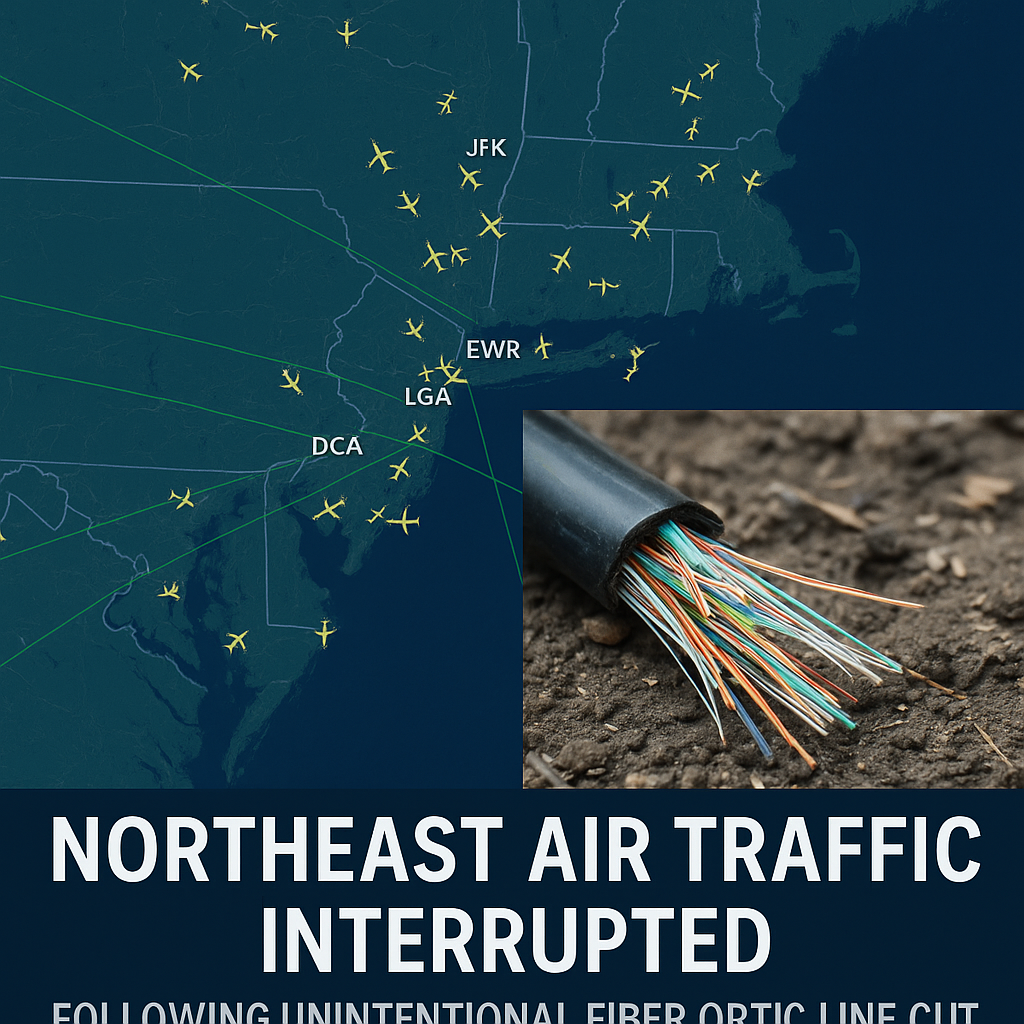
Yesterday presented significant challenges for air travel across the United States due to considerable failures in the air traffic control (ATC) system in the Northeast. These disruptions stemmed from an accidental severing of a backup fiber optic line, resulting in extensive delays and cancellations. The situation commenced around 9:45 AM EDT on September 21, 2026, when a critical telecommunications line in New Jersey, vital for the Federal Aviation Administration (FAA), was cut. Consequently, arrivals were halted at major airports such as Boston (BOS), New York (JFK & LGA), Newark (EWR), and Philadelphia (PHL). Resolving the issue took more than eight hours, with normal operations not resuming until after 6:30 PM. The fallout created a ripple effect on airline operations, with United Airlines facing the most substantial impact, closely followed by American and Delta. The timing was particularly unfortunate as global leaders were heading to New York for the United Nations General Assembly.
The failure of the fiber optic line initiated a blame game. Initially, Transportation Secretary Sean Duffy pointed to an Amtrak construction crew as the cause, but it was later clarified that the blame lay with an NJ Transit contractor. NJ Transit maintained that the contractor was not liable due to inaccurate utility markings. Verizon, the proprietor of the fiber optic line, disclaimed any accountability, asserting that their facilities were functional prior to the incident. The severed line, designed as a safeguard to avert such disruptions, underscored a deficiency in system redundancies. Despite the resolution of the issue, the incident highlighted weaknesses in the ATC infrastructure and the imperative for enhanced contingency strategies.