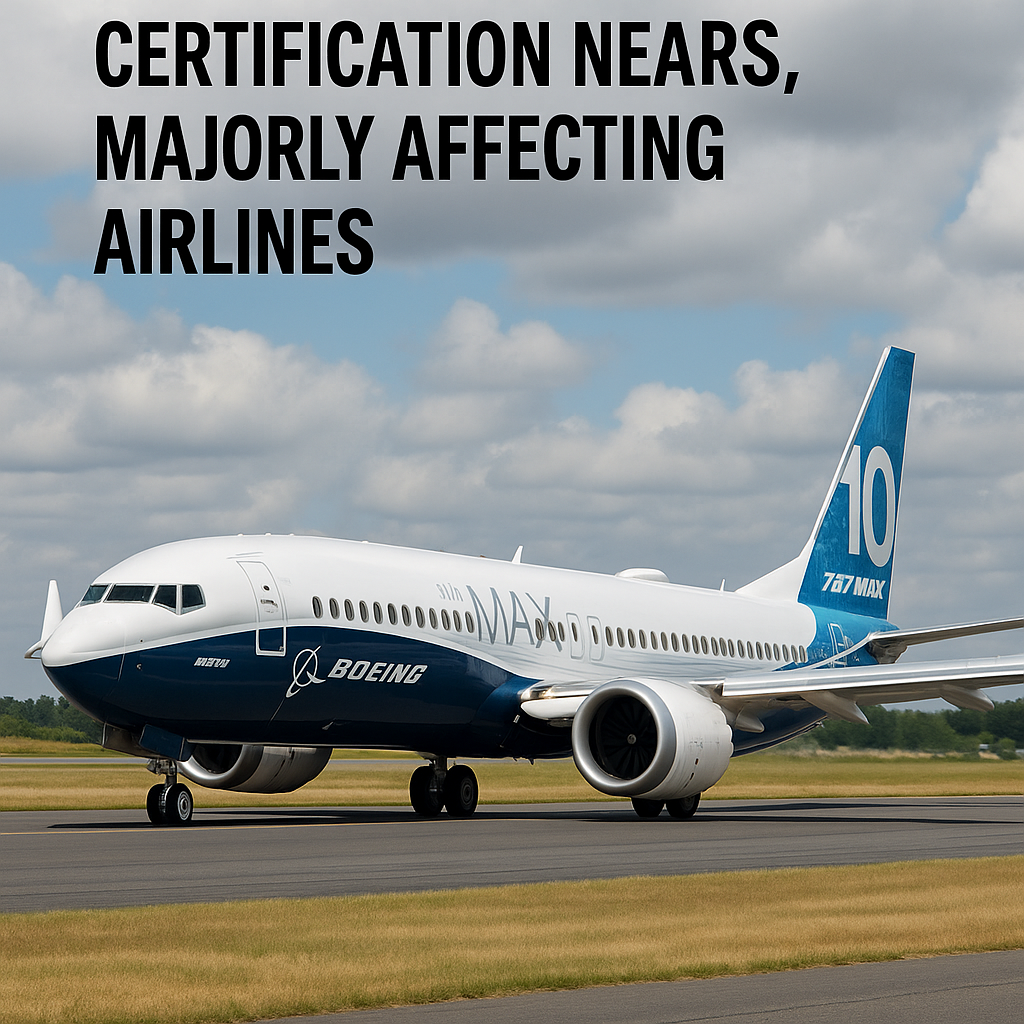
It is clear that Boeing has faced a challenging few years regarding the certification of new aircraft. Until recently, the aerospace leader had not yet obtained certification for the 737 MAX 7, 737 MAX 10, and 777X.
Fortunately, things at Boeing are beginning to change for the better. The Federal Aviation Administration (FAA) has recently certified the 737 MAX 7, which is fantastic news for Southwest (the primary airline with this aircraft on order). We anticipated that certification for the 737 MAX 10 wouldn’t be far behind, and it now appears that we might be just days away from that occurrence.
Boeing 737 MAX 10 is anticipated to be certified shortly
Reuters reports that Alaska Airlines expects the Boeing 737 MAX 10 to achieve certification before the end of September, likely within the next six days.
While Alaska is an airline and not a manufacturer, it’s reasonable to think they have grounds for this expectation, particularly due to their strong partnership with Boeing. Additionally, Alaska is projected to be the first U.S. customer for the aircraft (with WestJet set to be the global launch customer).
This aligns with recent statements from Boeing executives, including CEO Kelly Ortberg, who indicated last week that the certification for the 737 MAX 10 is expected to come “very soon.”
It’s important to highlight that even after certification, it will take additional time before the aircraft can actually begin service. Alaska’s executives point out that they still need to finish certification processes related to the heads-up display utilized by pilots after the aircraft is certified, and that may take several months. The Seattle-based oneworld carrier aims to have the first aircraft in service by April or May of 2027.
For context, the 737 MAX 10 is the version of the 737 family that offers the highest capacity yet also has the shortest range. Clearly, there is a trade-off between size and range, as all variants share the same types of engines. The 737 MAX 10 is set to provide the most cost-effective per-seat economics of any Boeing narrow-body aircraft ever manufactured.
The Boeing 737 MAX 10 holds significant implications for airlines
The recent certification of the Boeing 737 MAX 7 carries major consequences for Southwest, which has placed orders for hundreds of these aircraft, while few other airlines have made substantial orders for this type. The situation with the 737 MAX 10 paints a different picture.
There are nearly 1,500 firm orders for the 737 MAX 10. In the United States, Alaska, American, Delta, and United each have orders for 100 or more of this model. Similar large orders are noted from Ryanair, WestJet, Pegasus Airlines, Akasa Air, and others, indicating that this aircraft is immensely favored by airlines.
The appeal of the 737 MAX 10 is evident — it boasts excellent per-seat economics, so if airlines do not require the additional range of smaller variants (which most do not since transoceanic travel isn’t their focus), opting for the largest variant makes sense for enhanced seating without significantly increased operational costs.
However, this situation could also be somewhat precarious. Seats only hold value if they are occupied. Operating a larger variant with theoretically superior per-seat economics can become a challenge if the plane isn’t near full capacity:
– This “concern” is precisely why Southwest has adopted a cautious approach, concentrating on the 737 MAX 7 and 737 MAX 8, foregoing orders for the 737 MAX 9 or 737 MAX 10 (which may not be the best strategic choice, especially with the airline introducing additional legroom seating and future plans for first-class options).
– Additionally, transitioning to larger aircraft has proven to be a genuine challenge for ultra-low-cost carriers in the U.S., who were drawn to the appealing low cost per air seat mile but found it difficult to achieve full occupancy.
For passengers in the U.S., the 737 MAX 10 is expected to be an excellent aircraft. It seems plausible that airlines might not fully utilize the additional space to increase seating capacity significantly, but rather incorporate more premium seating options.
We’re aware that American and Delta both plan to include at least 24 first-class seats on these planes, which exceeds the capacity they’ve had on any narrow-body fleet type. Meanwhile, United continues to face challenges. I expect there will also be numerous extra legroom seats. It’s likely that U.S. airlines will aim to keep the seat count below 200 to avoid needing more than four flight attendants.
In summary
The Boeing 737 MAX 10 is anticipated to receive its certification shortly, just weeks after the certification of the 737 MAX 7.