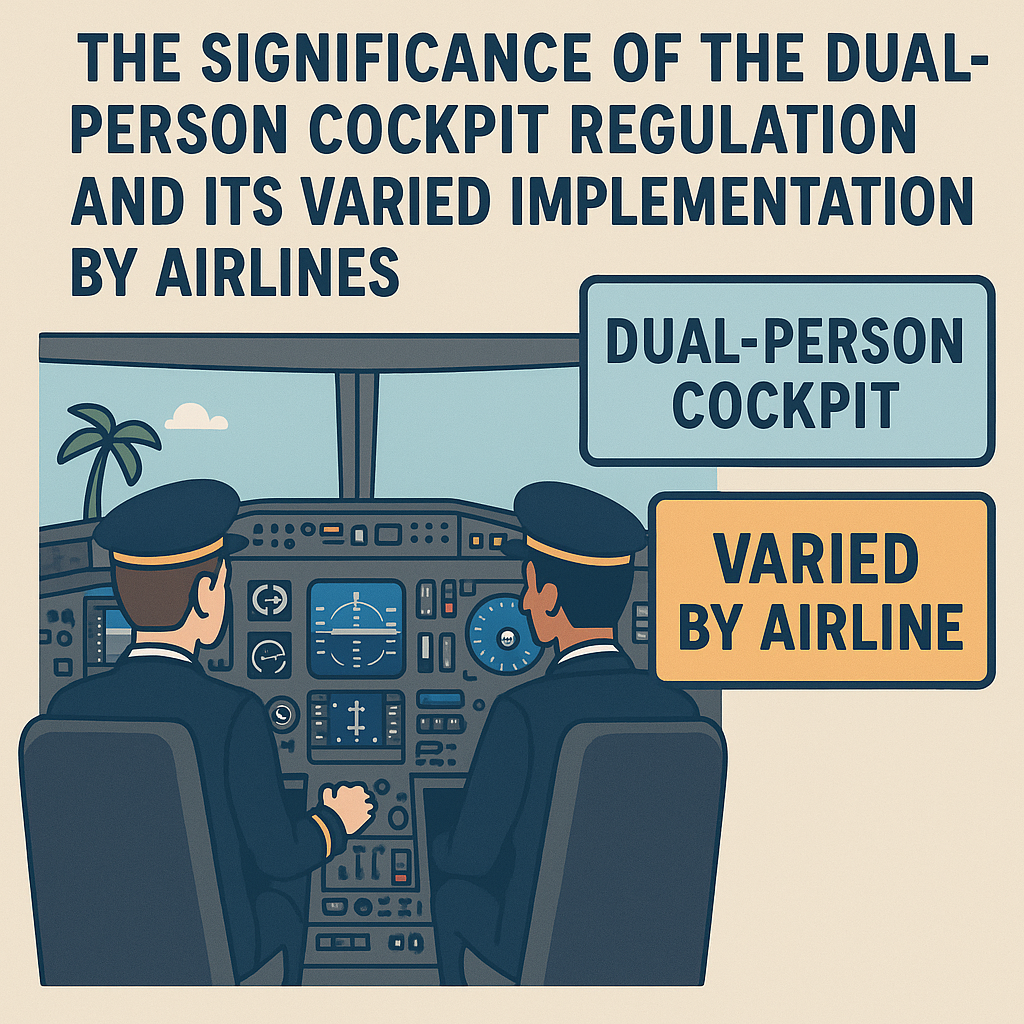
The aviation sector is well-known for its stringent emphasis on safety, allocating substantial resources to glean insights from incidents and possible hazards to avert future happenings. Nonetheless, an observable anomaly arises with the two-person cockpit rule, which is applied unevenly across the globe.
The two-person cockpit rule stipulates that there must always be a minimum of two people present in the cockpit. In the United States, if one pilot exits the cockpit, a flight attendant intervenes to maintain this regulation. However, this is not a consistent standard, as various countries and airlines do not implement it, sometimes leaving pilots alone in the cockpit.
The main worry is not pilot incapacitation, since cockpit access codes can mitigate that risk. The more urgent concern lies in pilot mental health, particularly in scenarios where a pilot might deliberately restrict access to the cockpit. Pilots grappling with mental health challenges may refrain from seeking help due to the fear of license revocation, and being solitary in the cockpit could enable them to act on harmful intentions without confronting those impacted.
Multiple incidents reveal the hazards tied to having a lone pilot in the cockpit. Prominent instances include the intentional crashes of a LAM Mozambique Embraer E190 in 2013, a Germanwings Airbus A320 in 2015, and the enigmatic disappearance of Malaysia Airlines Flight MH370 in 2014, all involving pilots locking their colleagues out of the cockpit.
In the wake of the Germanwings incident, the European Aviation Safety Agency (EASA) advised the implementation of the two-person cockpit rule, but subsequently permitted airlines to evaluate their own risks, which led some, like Lufthansa Group, to retract the policy. Recent occurrences, such as the flydubai incident, highlight the necessity of having two individuals present in the cockpit to avert possible catastrophes.
The irregularity in the enforcement of the two-person cockpit rule prompts inquiries regarding its perceived significance. While some may minimize its importance, the likelihood of averting tragedies indicates that it ought to be considered a global standard practice. The discussion persists regarding whether the rule should be uniformly mandated to bolster aviation safety.