Individuals hold strong views on nearly every aspect of the travel industry, and luggage is no exception. In this article, I aim to tackle one of the most debated subjects in the luggage realm — is a spinner suitcase worth it? I have firm beliefs regarding this matter, but I recognize that others strongly oppose my stance.
What are spinner suitcases?
For those who may not know the terminology, a spinner suitcase is an upright piece of luggage equipped with four wheels (in contrast to roller luggage, which typically features just two wheels). Although this isn’t a hard and fast rule, spinner suitcases are frequently hard-sided, while roller bags generally tend to be soft-sided.
Recently, it appears that spinner suitcases have surged in popularity, with many luggage manufacturers transitioning from two wheels to four wheels for their products. So, what are the advantages and disadvantages of spinner versus roller bags?
The pros of spinner suitcases
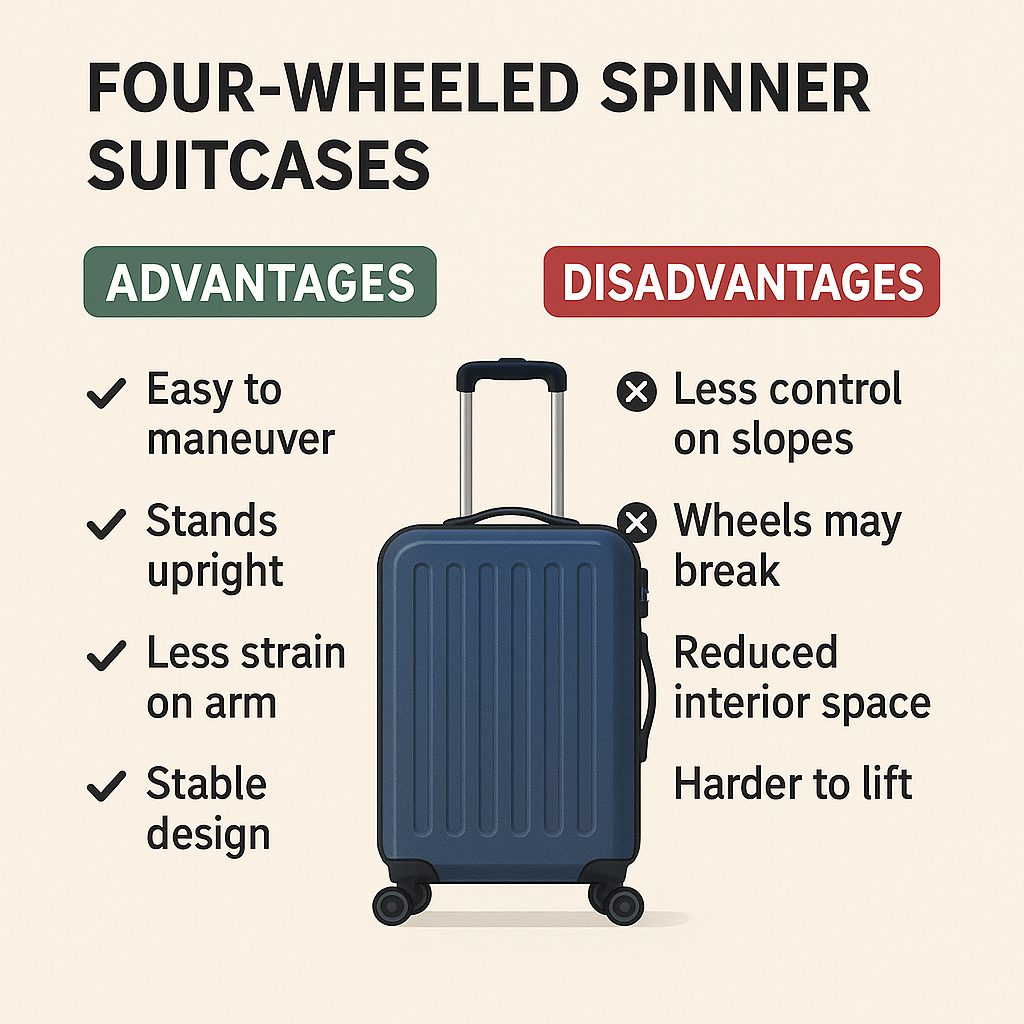
There are numerous advantages to spinner suitcases in comparison to roller luggage:
- Spinner suitcases offer significantly more flexibility, allowing you to roll them beside or in front of you, which isn’t as practical with roller luggage.
- Spinner suitcases provide enhanced maneuverability, enabling them to be rolled sideways into narrower spaces; this is particularly useful when navigating through an airplane aisle or passing through an automated immigration kiosk or train turnstile.
- On flat and smooth surfaces, spinner suitcases can be easier to maneuver, as they experience less friction, and there’s reduced strain on your arm and shoulder.
- Spinner suitcases are often hard-sided, which many people prefer, as this can enhance durability and protect the contents of your bag.
The cons of spinner suitcases
However, there are also several drawbacks to spinner suitcases compared to roller luggage:
- Spinner suitcases often have external wheels, which can detract from maximizing space, as they protrude; when placing your carry-on in a sizer, the wheel area is factored into the limit.
- While spinner suitcases excel on flat surfaces, they can become cumbersome when navigating inclines, in moving vehicles (like trains or subways), or on uneven terrains.
- Not all bags are equally robust, and sometimes wheels can break; there is a higher chance of problems when using four wheels instead of two, especially since spinner suitcases often feature external wheels.
- Spinner suitcases are more likely to be hard-sided, which does not optimize space and doesn’t allow for expansion when you need to carry more items.
I’m in the anti-spinner luggage camp
I must admit that this is a divisive issue in my home. Ford exclusively uses spinner bags with four wheels for both carry-ons and checked luggage (he opts for Rimowa bags). He claims I’m too practical. In contrast, I use roller bags with two wheels (I choose Briggs & Riley) for both types of luggage. I argue that Ford’s approach isn’t practical enough.
Does Ford’s Rimowa have a more appealing appearance than my Briggs & Riley bag? I would say yes (though I find that Rimowa bags scratch quite easily… perhaps that contributes to their appeal?). Personally, I don’t consider Briggs & Riley bags to be particularly stylish, yet they are remarkably durable (I switched from Tumi several years ago and have been very pleased with my choice).
However, putting style aside, I can’t help but note that during our travels together, my bag tends to perform better than Ford’s. Whenever we encounter anything other than a flat, smooth surface (which happens quite often), I find that my bag provides a smoother experience.
I realize that some people believe that using a two-wheeled bag can be more taxing on the wrists and heftier than a spinner bag. My solution