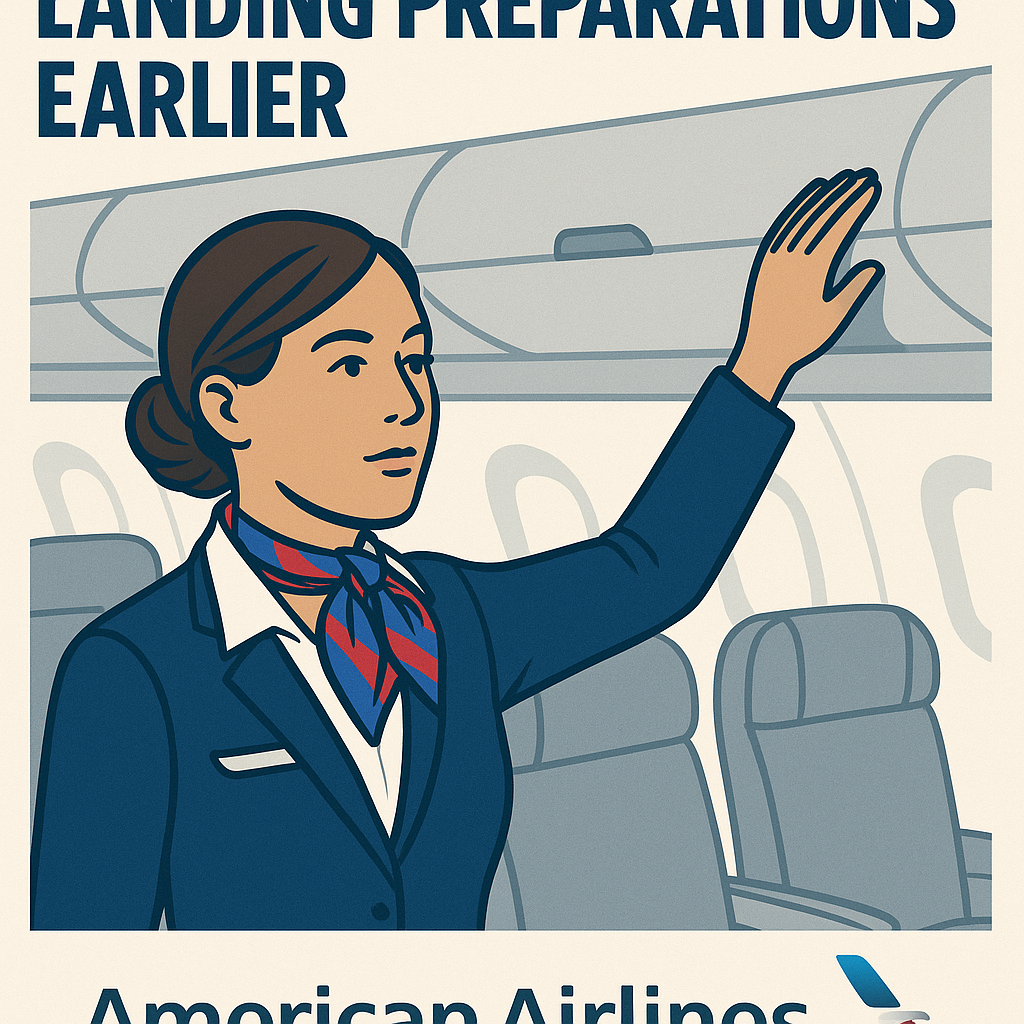
In the not-so-distant future, travelers flying with American Airlines might observe a slight alteration in the timing of when crews make the cabin ready for arrival, with certain consequences for passengers, as highlighted by PYOK.
In this article:
American revises cabin landing preparation guidelines
As is customary across nearly every airline, flight attendants ready the cabin for landing at some point before touchdown. This entails halting in-flight service, having passengers secure their belongings (including laptops), and requesting that passengers position their seats and tray tables upright.
The Association of Professional Flight Attendants (AFA), representing American’s flight attendants, has recently notified its members of an upcoming policy change.
Under the new protocol, flight attendants will initiate cabin preparations for landing at an altitude of 18,000 feet and will then take their jumpseats as quickly as possible, well ahead of the aircraft descending through 10,000 feet. Consequently, when the double chime is sounded (at 10,000 feet), all flight attendants should already be seated in their jumpseats.
Historically, American flight attendants completed final cabin preparations as the aircraft navigated through 10,000 feet. With these modifications, that process will commence 8,000 feet higher. Depending on an individual flight’s descent profile, this will generally mean the cabin will be ready for landing approximately four to eight minutes earlier than it has been in the past.
As you might expect, this implies that passengers will have reduced time to utilize their laptops, and crews will likewise have less opportunity to provide service. While this shouldn’t affect service on longer flights, on very short flights where drink service is offered, it may restrict the crew’s capacity to deliver a full service.
American is revising its cabin preparation protocols
Reasons behind American’s cabin preparation policy changes
What is motivating this policy shift at American? Here’s how the union conveys the reasoning for the change:
“Turbulence continues to be a leading cause of occupational injuries for flight attendants. Unlike passengers, flight attendants are often standing, walking, providing service, or fulfilling compliance responsibilities when turbulence strikes. The updated procedures aim to allow more time for cabin preparation, enhance communication about expected conditions, and minimize the exposure time for flight attendants to turbulence while carrying out essential duties during descent.”
Interestingly, Southwest implemented a comparable policy modification a few years back. At that time, the airline asserted that this policy adjustment was based on years of research, in addition to feedback gathered through the airline’s safety management system.
Utilizing thousands of data points from flight attendants and pilots, alongside data from the flight data analysis program, the assumption was that this policy alteration could lower flight attendant injuries by at least 20%.
While turbulence can occur at any height, the risk is certainly higher at lower altitudes, where encountering turbulence and flying through thick clouds is more prevalent. Reducing injuries is, of course, a logical and reasonable goal.
I would be interested to know the total number of injuries among flight attendants during the descent phase, and how many of those are deemed significant. Yes, incidents occur, but in terms of Southwest, we are referring to 20% of what total number?
This policy adjustment aims to decrease injuries
Conclusion
American Airlines crews will soon begin the process of preparing cabins for landing at 18,000 feet, instead of 10,000 feet. The intention is for crews to be secured in their jumpseats by the time the aircraft descends to 10,000 feet. This is designed to lower injury rates among flight attendants, considering the heightened risk of turbulence at lower altitudes. This is a relatively minor change, but passengers may still perceive this policy adjustment, as it will affect seat recline, laptop use, and more.
What are your thoughts on American modifying its cabin landing procedures?