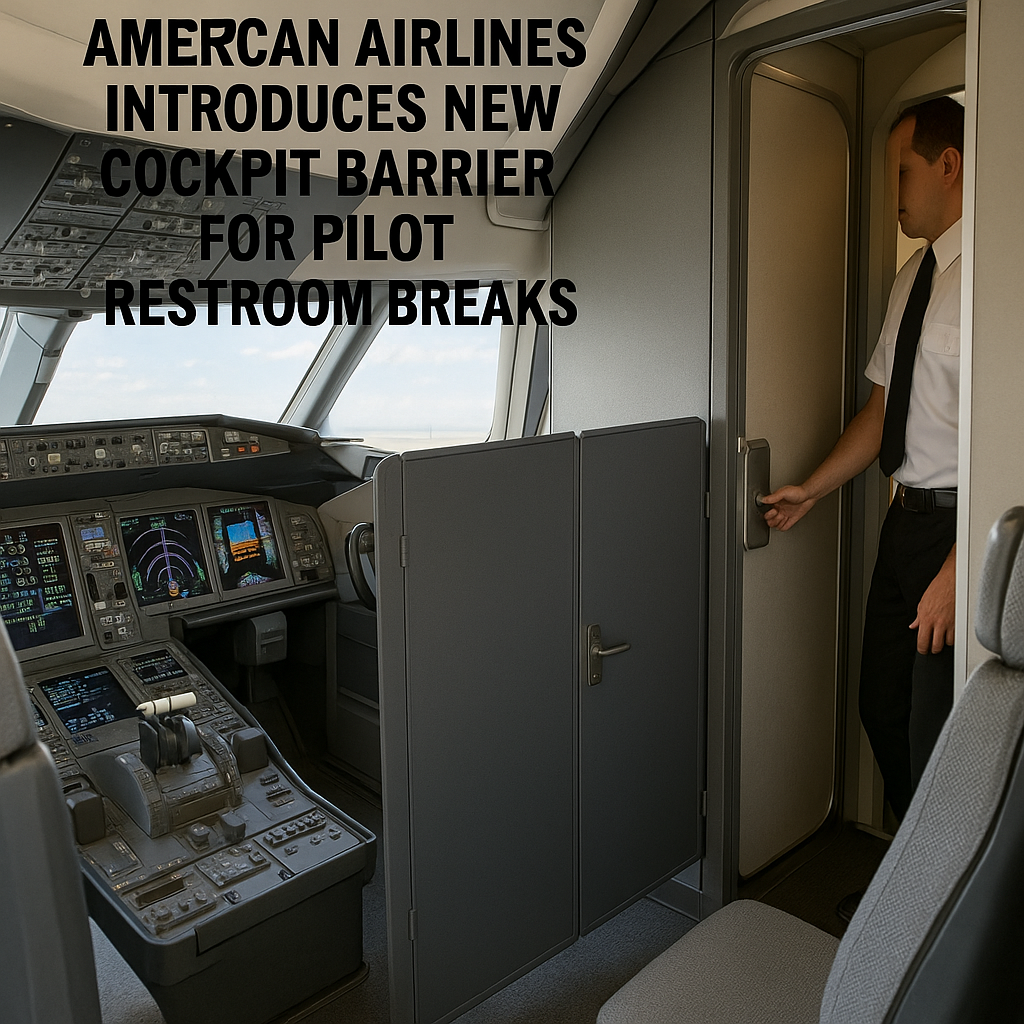
If you frequently travel with American Airlines, you might observe a new protocol starting today regarding pilots using the restroom. This will soon be extended to certain aircraft across all US carriers, but American is among the pioneers in putting this into practice, so let me clarify what is happening.
In this article:
American introduces new cockpit barrier feature
It’s routine for pilots to use the restroom during a flight. When they do so, it’s customary for flight attendants on US airlines to obstruct the aisle with a galley cart, preventing any passenger from entering the flight deck while the door is open.
In 2025, the Federal Aviation Administration (FAA) enacted a new regulation mandating a secondary barrier on the flight deck of commercial aircraft in the United States, aimed at ensuring the safety of the plane, crew, and passengers. The FAA explained that the goal is to delay any attack on the flight deck sufficiently so that it can be closed and secured before an assailant can access it.
Consequently, aircraft manufacturers were required to equip all newly delivered planes with these barriers starting from August 2025. Originally, the obligation to utilize them was set to begin then, but that schedule has been postponed to July 2026 to provide adequate time for training. Notably, there are no definite plans to require retrofitting of existing aircraft with this feature.
As reported by PYOK, American has commenced using these cockpit barriers fleet-wide starting today, Thursday, June 18, 2026. These are officially referred to as the “Installed Physical Secondary Barrier,” or IPSB. Although these barriers have been in place on new aircraft for almost a year, they have yet to be actively utilized. In recent months, flight attendants have completed training on how to operate them.
American Airlines is only the second major US airline to begin implementing these barriers, following Southwest, which started using them almost immediately after installation.
However, currently, only a minor fraction of planes are equipped with these barriers, so do not expect to see them consistently. Therefore, if you wish to determine the delivery date of your aircraft without looking it up, check for this barrier as an indicator that it’s relatively new.
Is a secondary flight deck barrier essential?
It’s obvious that aviation safety has significantly improved over the years due to various incremental advancements. Indeed, the introduction of this second cockpit barrier is the last recommendation from the 9/11 Commission to be put into action.
Despite this, it appears to be a solution that addresses a relatively minor concern. How many individuals have successfully accessed the flight deck of a commercial aircraft in the two decades since 9/11? I believe the answer is none worldwide, but feel free to correct me if I’m mistaken.
Several factors contribute to this:
– The presence of fortified flight deck doors prevents unauthorized access
– The perception of hijackings has evolved; in the past, airline employees might have let a person into the flight deck under threat, but such occurrences are unlikely in a post-9/11 context
– Passengers are less likely to tolerate hijackings now; previously, they may have cooperated with hijackers, thinking it would minimize harm, but I believe that mindset has shifted since 9/11.
Let’s examine another aspect of secured flight deck doors. How many planes have crashed in the last 13 years due to a pilot being locked out of the flight deck?
– In November 2013, LAM Mozambique flight 470 crashed when the captain was inside the flight deck while the first officer was excluded.
– In March 2014, Malaysia Airlines flight 370 disappeared, with prevailing theories suggesting the captain hijacked the plane while the first officer was locked out.
– In March 2015, Germanwings flight 9525 went down when the first officer was in the flight deck while the captain was locked out.
– In March 2022, China Eastern flight 5735 crashed in what is suspected to be pilot suicide, although China has not acknowledged this.
While I’m not proposing that we eliminate reinforced flight deck doors, one must consider how many lives have truly been safeguarded because of them.
In my view, the mental health of pilots and having a single individual in the flight deck pose a far greater risk to aviation than the number of flight deck barriers. Admittedly, this is more of a global concern than one specific to the US — at least US airlines are mandated to always have two crew members in the flight deck, which is why a flight attendant