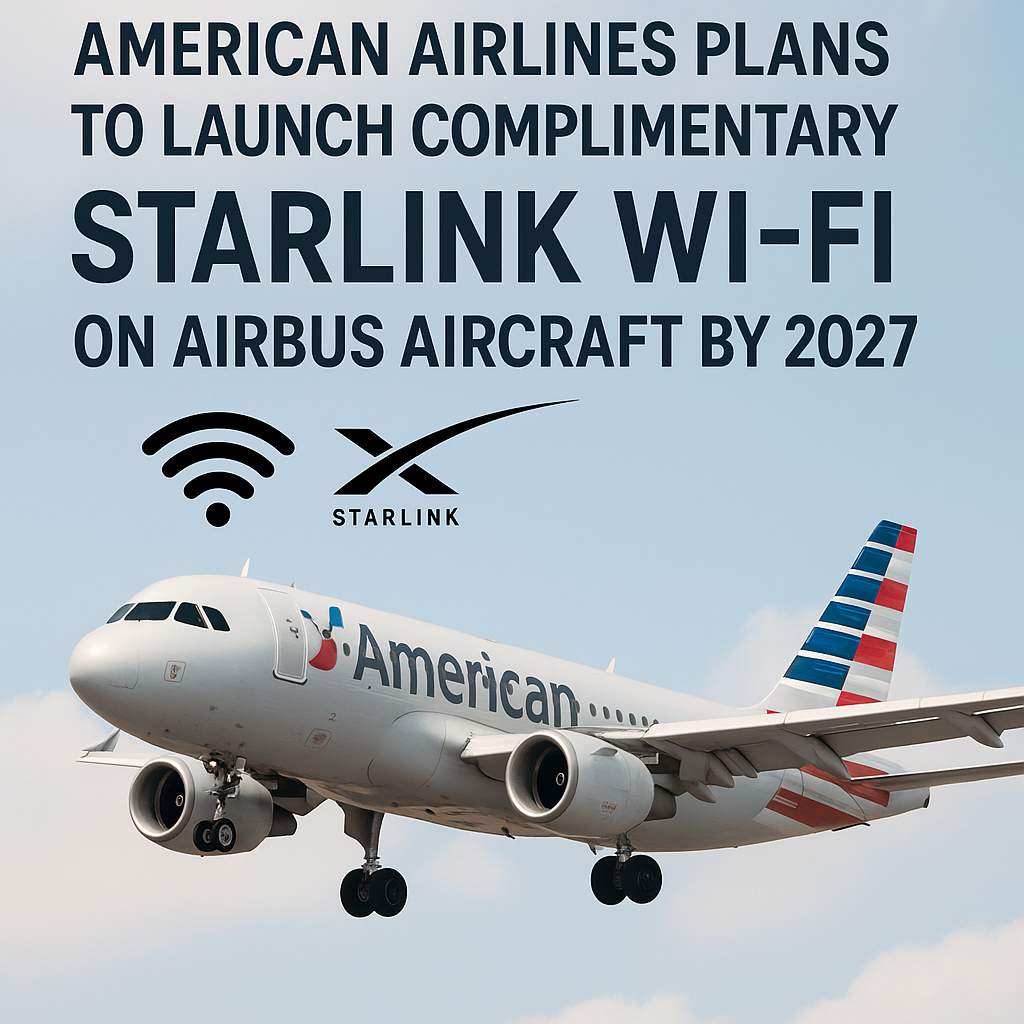
Currently, we are observing a notable shift in inflight Wi-Fi services, as airlines progressively incorporate Starlink Wi-Fi. This offering provides internet speeds that are similar to those on the ground, outpacing the frequently unreliable performance of competing services such as Viasat. Major US airlines, including Alaska, Hawaiian, Southwest, and United, have adopted Starlink, whereas Delta has chosen Amazon Leo, a choice that has garnered some scrutiny due to its schedule.
American Airlines has now entered the fray, revealing its intention to enhance its inflight Wi-Fi by collaborating with SpaceX to roll out Starlink Wi-Fi. The implementation is expected to commence in early 2027, covering over 500 aircraft, specifically the Airbus A320 family, which includes A319s, A320s, A321s, A321neos, and A321XLRs. This service will be offered at no cost, with no obligation for passengers to hold AAdvantage membership.
Starlink is famed for its high-speed, low-latency broadband internet, accessible from boarding to disembarkation. It accommodates live streaming, gaming, e-commerce, and productivity needs, ensuring a smooth online experience akin to being on the ground. The burgeoning appeal of Starlink among airlines is clear, with carriers such as Aer Lingus, airBaltic, Air France, Air New Zealand, and numerous others announcing intentions to implement the service.
At present, American Airlines operates Viasat Wi-Fi on most narrow-body aircraft and Panasonic Wi-Fi on wide-body models. Wi-Fi is complimentary for AAdvantage members on Viasat-equipped planes, making American’s current Wi-Fi functionalities competitive. Heather Garboden, American’s Chief Customer Officer, highlights that partnering with Starlink aligns with the airline’s dedication to improving customer travel experiences by delivering dependable, high-speed connectivity.
Although American’s initiative to bring in Starlink Wi-Fi is admirable, it trails United’s initiative, which began installing Starlink Wi-Fi 18 months beforehand. American’s strategy to equip less than half of its fleet, excluding Boeing and Embraer aircraft, raises concerns about the extensiveness of this upgrade. Nevertheless, the announcement is a favorable progress, placing American ahead of Delta, which awaits Amazon Leo, anticipated in 2028.
In summary, American Airlines’ strategy to implement Starlink Wi-Fi starting in 2027 is a promising advancement, albeit it will only encompass around 500 narrow-body Airbus aircraft. This initiative positions United as the leader among the “big four” US airlines in adopting next-generation Wi-Fi, followed by Southwest, American, and Delta. The aviation sector eagerly looks forward to further announcements from American, which may include the reinstatement of seat-back TVs on narrow-body aircraft.