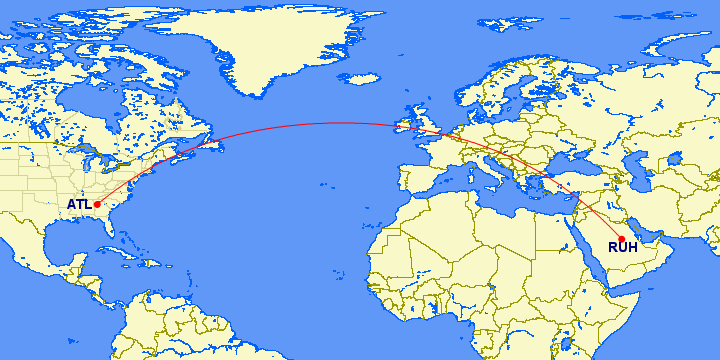
In July 2024, Delta and Riyadh Air revealed intentions to establish a collaboration, encompassing the Atlanta-based airline’s introduction of flights to Saudi Arabia. Subsequently, in October 2025, Delta officially unveiled plans to operate flights to Saudi Arabia. An additional update has surfaced, as the flight schedule has been released, with ticket sales anticipated to commence soon.
Delta will commence flights to Riyadh, Saudi Arabia, starting October 2026.
Beginning October 23, 2026, Delta intends to initiate flights connecting Atlanta (ATL) with Riyadh (RUH). The service will run daily for the initial week, followed by three times a week thereafter, on a year-round basis. The flight is scheduled as follows:
DL318 Atlanta to Riyadh departing 10:30PM arriving 7:35PM (+1 day)
DL317 Riyadh to Atlanta departing 11:30PM arriving 7:05AM (+1 day)
The 7,283-mile trek is allotted 13 hours and 5 minutes eastbound and 15 hours and 35 minutes westbound, ranking it among Delta’s longest routes. Delta will deploy an Airbus A350-900 on this route, featuring a total of 275 seats, which includes 40 business class seats, 40 premium economy seats, and 195 economy seats.
Here’s Delta CEO Ed Bastian’s perspective:
“Launching service to Riyadh represents a pivotal milestone in Delta’s global expansion as we embark on our second century of aviation. Our new routes will link customers to this vibrant, rapidly evolving region while providing the care, comfort, and dependability they expect. It embodies our ambitious vision to create significant opportunities and experiences in all corners of the globe in the coming years.”
Conversely, here’s how Saudi Arabia Minister of Tourism Ahmed Al-Khateeb articulates this:
“We welcome Delta to Riyadh and eagerly anticipate the opportunities this service will generate for travelers globally. Delta’s new nonstop connection between Atlanta and Riyadh signifies an important stride in enhancing global connectivity between our countries and will unlock new avenues for tourism and cultural exchange while fostering business and innovation.”
For context, Riyadh Air is Saudi Arabia’s ambitious new airline venture, which has just initiated flights (although they are not available for public sale yet). It makes sense for Delta to operate from Atlanta, as it’s likely that Riyadh to New York (JFK) will be among Riyadh Air’s inaugural long-haul routes, prompting Delta to serve a complementary market by routing passengers through its Atlanta mega-hub.
Delta intends to operate flights from Atlanta to Riyadh.
What’s the reasoning behind Delta’s decision to launch flights to Riyadh?
In the short term, Delta’s rationale for flying to Riyadh is apparent. Saudi Arabia is extending substantial subsidies to any airline prepared to fly to Riyadh, to the extent that they can practically ensure they won’t incur losses flying to the nation.
Few airlines relish subsidies and loopholes more than Delta, so it’s obvious that this is the driving force here. US carriers typically do not earn significant profits from passenger flights, so if the airline can be guaranteed a profit when flying to Saudi Arabia, it’s an advantageous arrangement!
It has been somewhat amusing to hear Bastian’s justification for servicing Saudi Arabia, considering Delta’s historical opposition to Gulf carriers and subsidies (when it suits them).
Interestingly, I found it amusing when Bastian recently stated that Saudi Arabia is one of his favorite places he has visited in a long time (about nine minutes into the interview below).
Is there a broader long-term strategy in play? Quite possibly. Riyadh Air’s objectives are clear — the airline is backed by the Saudi Arabian government, aiming to enhance connectivity to and from Riyadh and boost tourism as part of the country’s long-term vision. The rationale is that Riyadh has been underserved for years, given its population size.
We are observing Riyadh Air forming alliances with other airlines preceding its launch. Beyond Delta, Riyadh Air is also collaborating with Air France-KLM and Virgin Atlantic, highlighting the “ecosystem” focus of the airline.
Years down the line, I could envision Riyadh becoming a logical connection point for Delta, once Riyadh Air’s network becomes established. This is particularly true if a close partnership between the two airlines develops.
The reality is that unlike American (aligned with Etihad and Qatar) and United (partnered with Emirates), Delta lacks a strong presence in the Middle East and does not have a “preferred” partner, leaving many destinations in the Middle East, Africa, and India without suitable connecting options. Thus, Delta is taking the measures available to them, as something is certainly better than nothing.
However, I personally don’t perceive this as a substantial opportunity for the airline, and there’s no denying that.