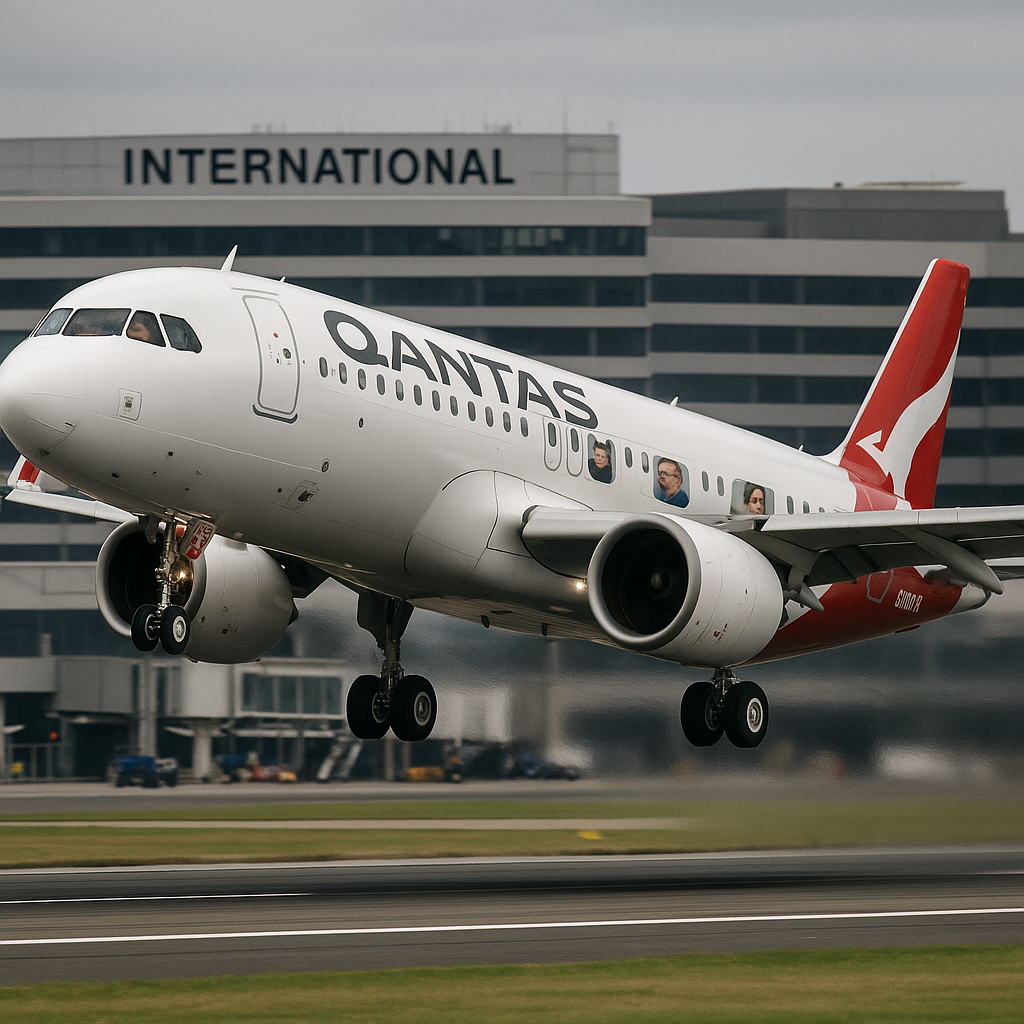
Several months prior, Qantas began receiving the Airbus A321XLR, an aircraft that the airline is employing in an atypical manner. Qantas’s main intention for this aircraft is for it to serve domestic routes, replacing the Boeing 737-800. Nonetheless, the airline is now planning to utilize this aircraft on one notably long international flight, which I believe will not please travelers.
Qantas Airbus A321XLR will operate from Brisbane to Manila
Starting October 25, 2026, Qantas plans to run daily nonstop services between Brisbane (BNE) and Manila (MNL) using the Airbus A321XLR. Leading up to this date, the flight is conducted 5 times weekly by the Airbus A330-200. This 3,596-mile route will adhere to the following timetable:
QF97 Brisbane to Manila departing 2:00PM arriving 8:05PM
QF98 Manila to Brisbane departing 9:30PM arriving 7:25AM (+1 day)
The flight duration is blocked at 8 hours and 5 minutes northbound and 7 hours and 55 minutes southbound.
This is noteworthy, as it marks the longest regularly scheduled narrow body route that Qantas has ever operated. Certainly, this fits within the operational capacity of the A321XLR, and perhaps Manila is not Qantas’ top yielding destination. However, it is intriguing to deviate from convention here, as this aircraft is fundamentally crafted for short- to medium-haul operations, based on its interior design.
The Qantas A321XLR designated for this route will feature 197 seats, comprising 20 business class seats and 177 economy class seats. While these aircraft lack seat back entertainment, they do offer complimentary Wi-Fi. Although the daytime flight in one direction might not be too bothersome, the overnight option does seem unappealing.
This is a fascinating direction for Qantas to pursue
I can certainly appreciate the desire to align the appropriate aircraft type with the corresponding route in regard to demand and revenue. The difficulty lies in the fact that this significantly contradicts what Qantas customers have come to expect. Historically, Qantas has not operated many Asian routes with regionally configured aircraft, even when it was feasible, with few exceptions.
Another point of interest is that the forward cabin continues to be promoted as business class, instead of premium economy. To be fair, US airlines also use two-cabin aircraft on some lengthier international flights, occasionally marketing the forward cabin as business class. Yet, we have also observed airlines promote the forward cabin as premium economy for longer journeys.
With this change in aircraft and much lower product quality, Qantas is not reducing business class fares. You will notice that the price remains the same on October 24, when it operates with an A330 featuring flat beds…
…as it does on October 25, when it switches to an A321XLR with recliners.
I must assume that sending the A321XLR to Manila serves as a sort of test, assessing how much customers will tolerate this change versus booking with a different airline. This is an intriguing initial route for such an experiment, as the sole competitor is Philippine Airlines, which has A321neos equipped with flat beds. I surmise that, with an Australia point-of-sale, there is a strong inclination for Qantas over Philippine Airlines.
In conclusion
Qantas will initiate operations of its new Airbus A321XLR on some longer international routes. By late October 2026, the Brisbane to Manila service will transition from an A330 to an A321neo, although frequencies will increase. Despite the aircraft transition, the airline will maintain the same business class pricing, even though passengers will have recliners without seat back entertainment—a downgrade from flat beds.
What are your thoughts on Qantas’ changing A321XLR strategy?