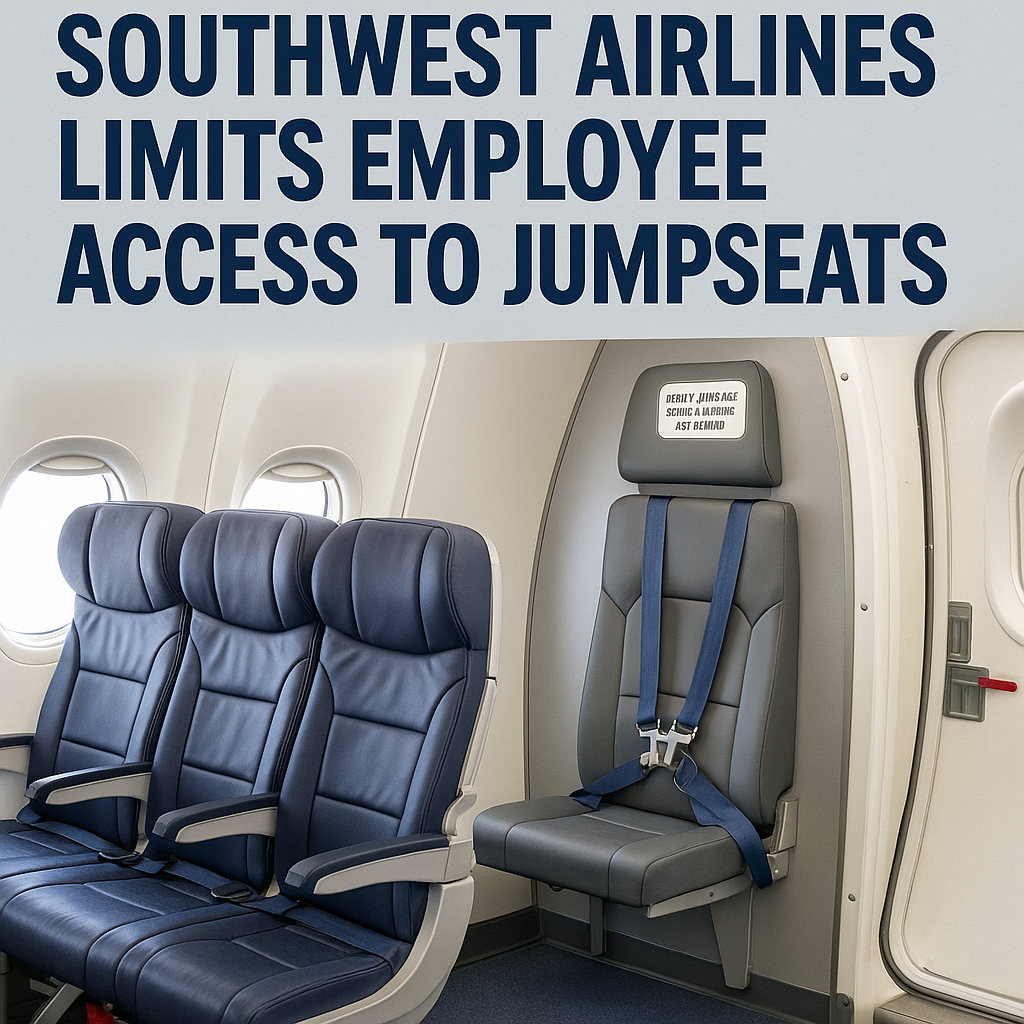
Southwest Airlines has recently revised its employee travel guidelines, specifically regarding the utilization of jumpseats for non-revenue (non-rev) travel. Previously, all staff members, including reservations and gate agents, had the opportunity to use flight attendant jumpseats when standard passenger seats were not available. This option proved to be beneficial for employees flying on a space-available basis, particularly during peak travel times when flights were filled to capacity.
However, under the updated policy, only pilots and flight attendants are permitted to occupy these jumpseats. This revision brings Southwest’s policy in closer alignment with industry norms, where generally only crew members are authorized to use jumpseats. The change has received a variety of responses. While it is considered a positive step for flight attendants and pilots, who now have improved access to these seats, it has been perceived unfavorably by other employee factions that have lost this travel advantage.
The Transport Workers Union (TWU) Local 556, which represents Southwest flight attendants, has been pushing for this modification, highlighting concerns related to safety and operational efficiency. The union contends that solely trained crew members should occupy jumpseats, as they are acquainted with emergency protocols and the operational requirements of the galley area.
This policy amendment appears to be a goodwill gesture towards flight attendants, who have encountered difficulties with recent changes at Southwest, including new seating regulations and overhead bin usage policies. By prioritizing jumpseat access for flight attendants and pilots, Southwest seeks to address some of the issues raised by the union and enhance its relationship with crew members.
In summary, while this alteration may restrict travel opportunities for some employees, it improves safety and conforms with industry practices, benefiting flight attendants and pilots commuting to work.