In this article:
Premium airplane seats equipped with three-point belts
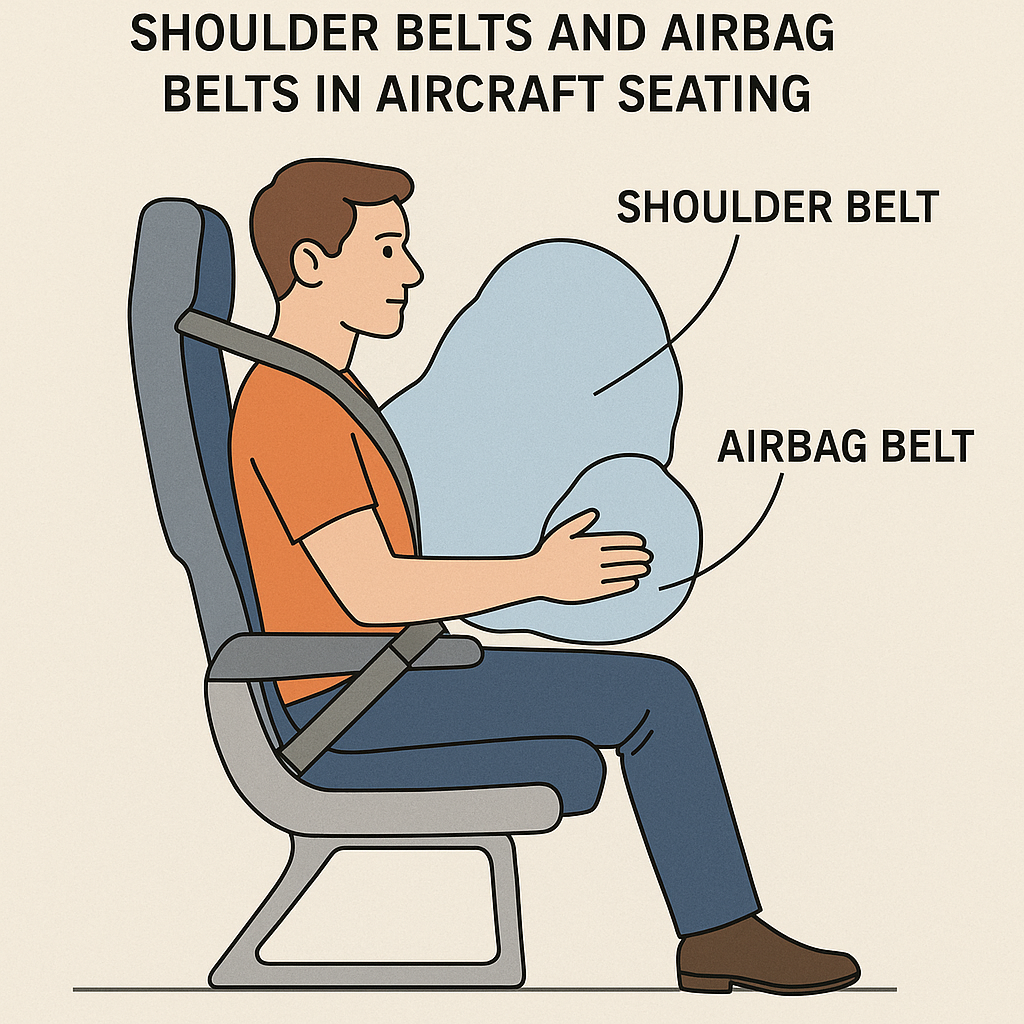
Generally, airplane seats come with lap belts, which are considerably less constricting than the seatbelts found in vehicles. While cars commonly feature three-point belts that are worn over the shoulder, such a design is seldom seen in airplanes. However, an exception exists in specific first and business class seats that do include shoulder belts. So, what is the reasoning behind this, and why is it mandatory for some premium seats while not for others?
The Federal Aviation Administration (FAA) in the United States enforces a “16g rule,” which stipulates that certain standards for crashworthiness must be satisfied in the case of an emergency. This regulation forms part of the intricate seat certification process, grounded in research, accident statistics, and analyses, and aims to enhance protection for passengers during impact-survivable incidents.
In the majority of seat types, shoulder belts are not mandated due to the configuration of aircraft cabins. For instance, in economy class, the design usually means that the soft seat back in front would “absorb” some of the impact in an accident.
Nevertheless, in premium cabins, the scenario changes, explaining the presence of shoulder belts in select seats. This is especially prevalent with seats that are not entirely forward or rear-facing, such as herringbone or reverse herringbone configurations.
This is crucial because if there’s a rapid deceleration and you are seated at an angle to the aircraft’s trajectory, your body might react differently, potentially increasing risk.
Shoulder belts are commonly found in reverse herringbone seats
However, shoulder belts can also appear in completely forward or rear-facing seats. This is generally applicable to cabins where the impact couldn’t be effectively mitigated in case of sudden deceleration. For instance, in a hard-shelled seat where there is a likelihood of hitting your head against a hard surface, a shoulder belt may become necessary.
Some forward-facing seats also feature shoulder belts
Airbag seatbelts serve as an alternative
Now, you might wonder, “but I’ve sat in a reverse herringbone seat without a shoulder belt, how could that be?” Airlines do have an alternative to the three-point belt. Instead of a shoulder harness, some seats may use airbag seatbelts (these are the thicker seatbelts available on certain airlines).
Certain seats utilize airbag seatbelts instead
From a comfort standpoint, there are advantages and disadvantages to the three-point belt compared to the airbag seatbelt. While the three-point belt may feel slightly less comfortable during taxi, takeoff, and landing (as it must be worn at those times), I like that it is not needed during cruising altitude.
Conversely, I find the airbag seatbelt can be somewhat more uncomfortable throughout the journey, particularly while sleeping, as its presence is more noticeable. Thus, it’s a trade-off between a belt that is more comfortable during takeoff and landing and one that offers more comfort in-flight.
In conclusion
While most airplane seats are fitted with a basic lap belt, others come with a three-point belt that crosses over the shoulder. These advanced belts are implemented in scenarios where regulations necessitate them, and they are predominantly found in seats that are not directly forward or rear-facing. As an alternative, airlines may choose to install airbag seatbelts, which are also fairly common in reverse herringbone seats.
For premium seats that need more than a lap belt, do you prefer three-point seatbelts or airbag seatbelts?