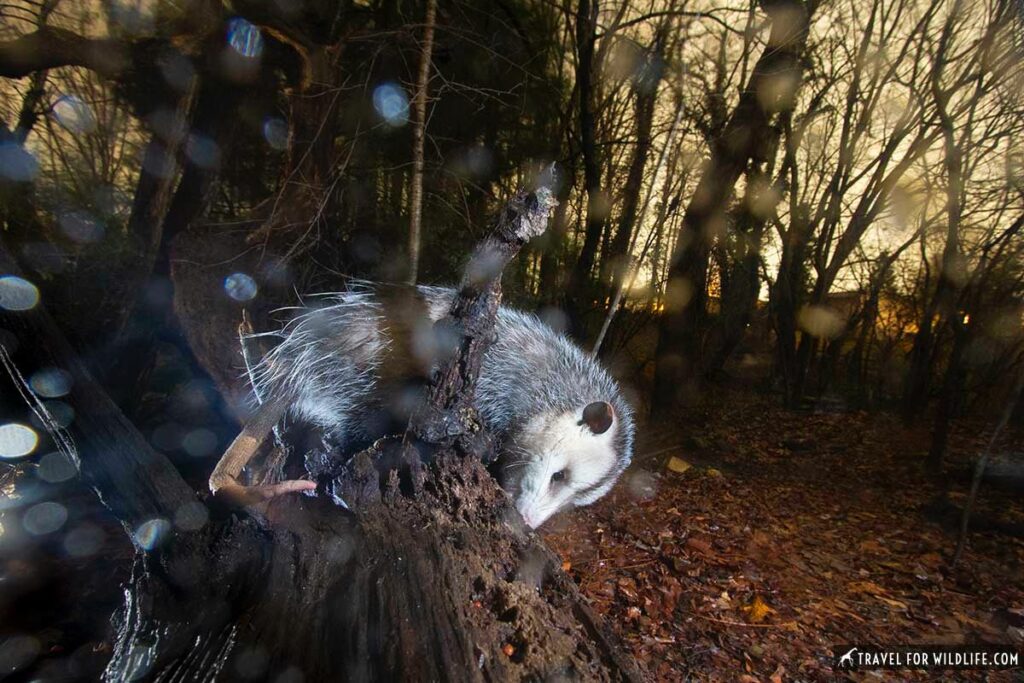
Virginia opossums (Didelphis virginiana) stand out as the sole marsupials found in the United States, and we take pride in sharing our yard with them. Since they are nocturnal, we seldom catch a glimpse of them, but our camera traps confirm their presence. Recently, we were able to capture a fascinating behavior of an opossum: the way it utilizes its tail. Take a look at the video below that showcases the opossum tail in action!
The opossum tail is utilized for transporting nesting materials
Opossums employ their prehensile tails to transport nesting materials (leaves, twigs, corn husks…) back to their dens. Here’s how it’s done: opossums gather leaves using their mouths and then transfer them to their front feet, and subsequently to their back feet. They wrap their tail around the top of the leaf bundle and carry this bedding with their semi-prehensile tails as though it were a fifth limb!
We have captured this behavior multiple times on our trail cameras. The video below represents the most recent instance, where an opossum is seen collecting leaves and bringing them to its den, situated just about 10 feet from our home. We intentionally leave our leaves scattered on the ground during the fall so that opossums, woodchucks, and squirrels can take them to their nests. Opossums do not excavate their own dens. Our neighbor here utilizes a woodchuck burrow. Leaves are used to line the den, enhancing insulation during the cold winter months.
Opossum tails are employed for balancing while climbing trees
Although young opossums can dangle by their tails (if compelled), adult opossums are too heavy and do not employ their tails for hanging. However, they do utilize them for maintaining balance and stability on branches during tree climbing.
Opossum tails are not meant for gripping
Dragging a fully grown opossum by the tip of its tail can inflict severe injury by dislocating tail bones.
For further information about opossums, check out our article Possum vs Opossum: What’s the Difference?