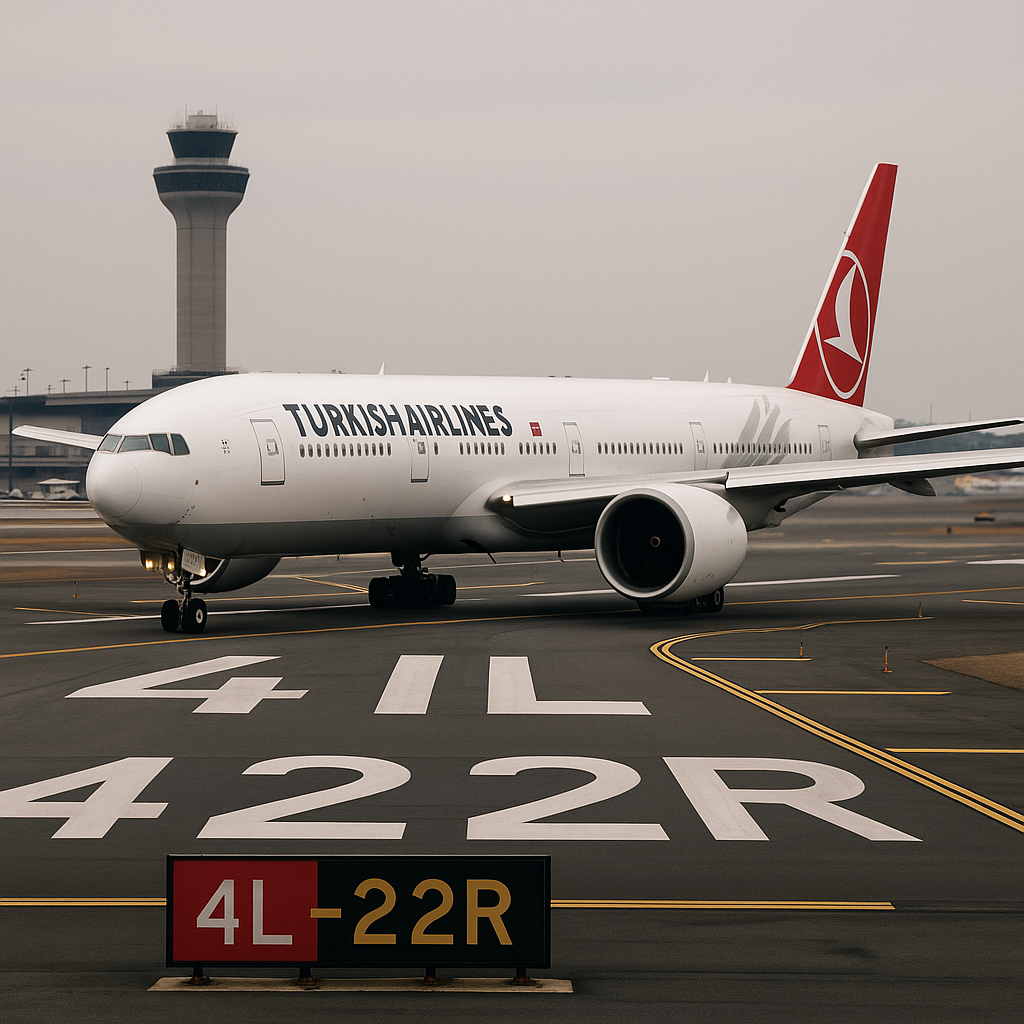
In the latest episode of “if only air traffic controllers in the U.S. utilized standard phraseology like their counterparts around the globe,” I bring to light a recent event that occurred at Newark, involving a departing Turkish Airlines flight.
Turkish Airlines pilots puzzled by ATC directives
This incident took place in the early morning hours of September 15, 2026, concerning Turkish Airlines flight TK30, an Airbus A350-900 traveling from Newark (EWR) to Istanbul (IST). The Turkish Airlines aircraft entered the runway without authorization. However, the pilots’ actions were not as reckless as they may seem.
Let’s take a moment to review. The exchange began with the air traffic controller granting permission for the Turkish plane to taxi:
Turkish pilot: “Control, good evening, Turkish 4YT heavy, ready to taxi.”
Newark ATC: “Turkish 4YT, Newark, expect runway 4L for departure, taxi via B.”
Turkish pilot: “Expecting runway for departure 4L via taxiway B, Turkish 4YT.”
Seems straightforward, right? The aircraft then started its taxi toward the runway, with communication continuing as follows:
Newark ATC: “Turkish 4YT heavy, you’ll be next for departure, advise when you’re ready, please.”
Turkish pilot: “We’ll advise when ready, Turkish 4YT.”
Turkish pilot: “Tower, Turkish 4YT, ready for departure.”
Newark ATC: “Roger, thank you.”
At this point, there was approximately a 50-second pause. It’s important to note that the aircraft was just short of the taxiway leading to the runway and not at the hold short point. It was also a quiet night, with no other aircraft nearby. Nevertheless, the controller clearly wanted clarification on why the plane wasn’t advancing to the hold short point for the runway:
Newark ATC: “Turkish 4YT heavy, are you able to continue for the runway?”
Turkish pilot: “Affirmative.”
Newark ATC: “Okay, continue for the runway.”
Turkish pilot: “Continue for runway, Turkish 4YT.”
The Turkish aircraft then taxied onto the runway, aligned, and waited:
Newark ATC: “Turkish 4YT heavy.”
Turkish pilot: “We need 30 seconds, Turkish 4YT.”
Newark ATC: “Uh, yes, you’re, you’re aware you’re on runway 4L, correct?”
Turkish pilot: “Affirmative, there’s a slight technical difficulty, just five seconds.”
Newark ATC: “Okay, I’m going to have to provide you with a phone number here because you were not cleared onto runway 4L.”
The aircraft then had to taxi off the runway, and the pilots received a phone number for a potential pilot deviation. You can listen to the ATC audio below, along with a visualization of the event.
Why can’t U.S. ATC adopt standard phraseology?
Nearly everywhere else globally, air traffic control employs standardized phraseology when engaging with pilots. This makes sense, considering the presence of pilots from diverse backgrounds worldwide, and if aiming for maximum safety, it is crucial to reduce the risk of misunderstandings.
To be clear, the Turkish Airlines pilots were at fault here, in the sense that in the United States, pilots are never permitted to enter the runway unless they receive explicit confirmation that they are cleared for takeoff or authorized to line up and wait. Such instructions were not provided here… period.
However, the clarity of this controller’s instructions left much to be desired, and I can see precisely how this occurred. The controller instructed the Turkish pilots to inform her when they were ready to depart (presumably for granting takeoff clearance), they indicated they were ready, and she then said “continue to the runway,” which they interpreted as granting permission to line up and wait.
Ultimately, this isn’t about determining which party is right or wrong; it’s about developing a system that reduces the potential for miscommunication. Instead of saying “continue for the runway,” the controller should have stated “continue your taxi,” or “continue your taxi, hold short of runway 4L.”
This incident was not an isolated case. Earlier this year, a Qatar Airways Cargo Boeing 777 experienced a very similar situation in Houston (IAH), where the aircraft also taxied onto the runway without permission due to language confusion.
I fail to see why the United States cannot prioritize training controllers to use standardized language. Again, while the pilots were at fault here, it is not solely the fault