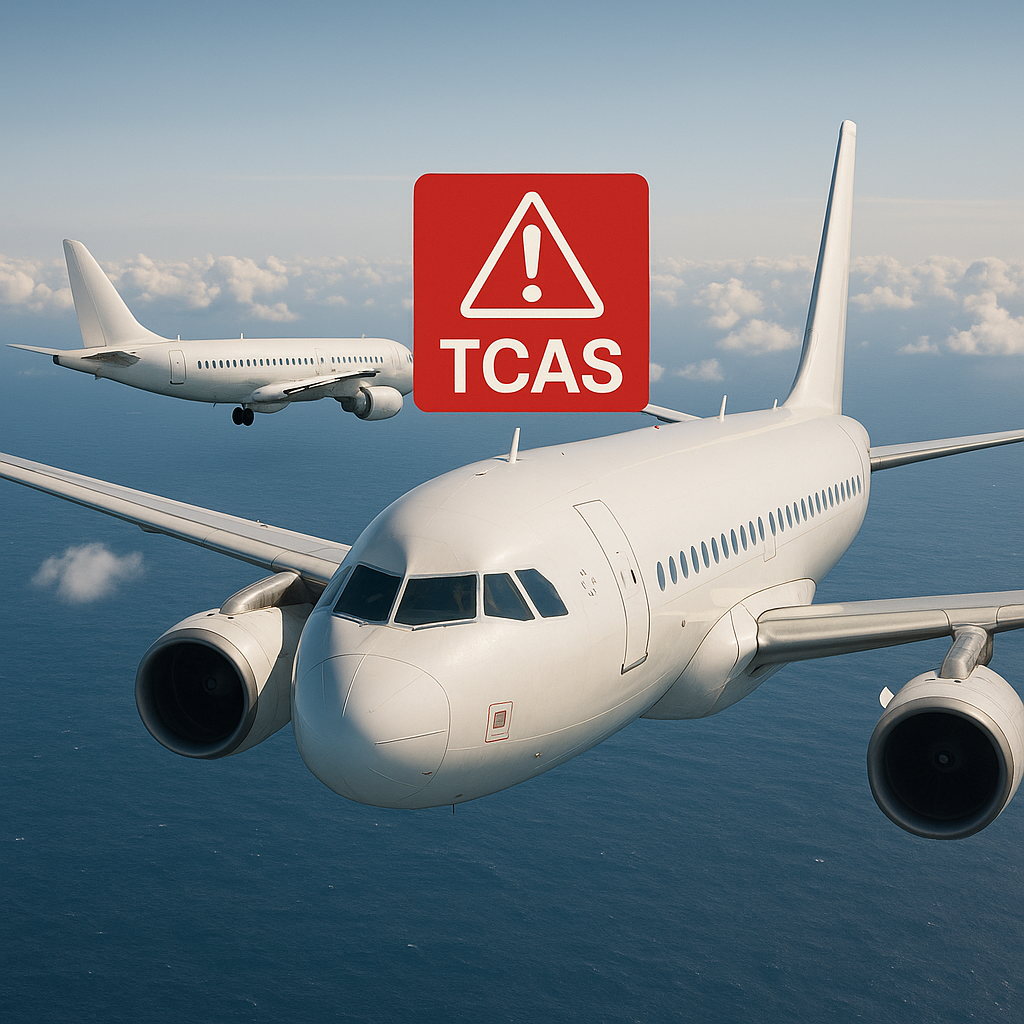
Every now and then, we observe near misses involving commercial airplanes. Generally, the nearer you are to an airport, the greater the likelihood of a near miss due to crowded airspace. Nevertheless, a rare event took place over the Atlantic Ocean at cruising altitude, where two aircraft approached each other head-on at the same altitude. Thankfully, the Traffic Collision Avoidance System (TCAS) stepped in.
**Air Europe & Iberia Jets Receive TCAS Alert Off the Coast of Africa**
The Aviation Herald reported an event on July 10, 2026, concerning two airplanes:
– An Air Europa Boeing 787-9 (EC-ODH) operating flight UX57 from Madrid to Sao Paulo.
– An Iberia Airbus A321XLR (EC-OLE) operating flight IB140 from Recife to Madrid.
At 1:23 AM UTC, both aircraft were flying at 36,000 feet over the Atlantic Ocean close to the West Saharan coastline. The Air Europa jet was heading southwest, while the Iberia plane was making its way northeast. Both aircraft were on airway N857, flying the same “track” but heading in opposite directions.
While navigating their designated routes, both planes received TCAS resolution advisory signals. TCAS gives pilots instructions on how to maneuver when traffic is perilously close. The Air Europa Boeing 787 ascended, whereas the Iberia Airbus A321 descended. Both aircraft proceeded safely to their final destinations.
Aircraft traveling along the same route but in opposing directions could result in disastrous outcomes, particularly given their combined closing speeds of 1,000 miles per hour.
**Was This a Pilot or Air Traffic Controller Mistake?**
Something went awry for two planes to trigger a TCAS resolution advisory at cruising altitude on a long-haul journey. Typically, aviation avoids head-on flight path intersections by allocating even thousands of feet to westbound flights and odd thousands to eastbound flights, although this may not always be the case in oceanic airspace.
The Iberia A321 started at 36,000 feet, descended to 35,000 feet due to the TCAS advisory, then ascended to 37,000 feet, and subsequently to 38,000 feet. It is still uncertain whether the pilots were off their designated altitude or if incorrect clearance was provided.
**Bottom Line**
An Iberia Airbus A321XLR and Air Europa Boeing 787-9 experienced a near miss over the Atlantic Ocean close to Africa, with a TCAS RA activating for both planes. The aircraft were on the same track but in opposing directions at the same altitude. Following the alert, one aircraft ascended while the other descended. This situation underscores a significant error, raising questions about the source of the mistake. What are your thoughts on this peculiar TCAS occurrence at cruising altitude?