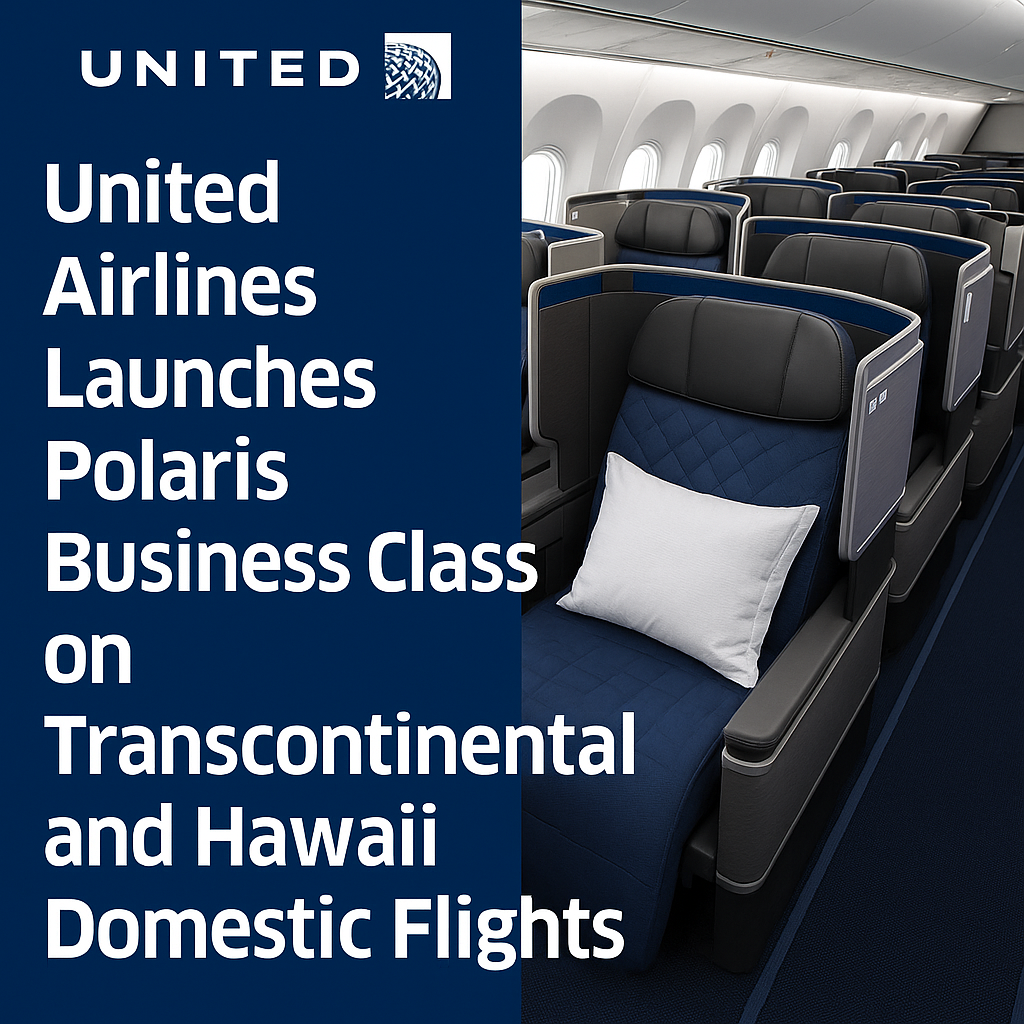
We anticipated this shift would occur, although it seems to have arrived a bit sooner than we had predicted, as noted by Zach Griff.
United renames certain domestic premium cabins to Polaris
Polaris business class refers to United’s long-haul, international business class experience. Traditionally, the front cabin on domestic flights has merely been advertised as first or business class, but not as Polaris business class. That situation has now changed.
With immediate effect, United has launched Polaris business class branding on select domestic routes:
- This is relevant in premium transcontinental markets, including flights from Newark (EWR) to Los Angeles (LAX) and San Francisco (SFO), and the reverse
- This is applicable in long-haul Hawaii markets, including routes from Chicago (ORD) and Newark (EWR) to Honolulu (HNL) and Maui (OGG), and vice versa
For clarity, I want to stress that this branding applies specifically when booking nonstop flights in these markets. Therefore, if you travel from Newark to San Francisco with a layover at another airport, you wouldn’t automatically be booked in Polaris business class.
Although United recently introduced “basic” Polaris fares, these are not currently being offered on domestic Polaris flights. It’s reasonable to assume that these fares will also be launched, so it’s merely a matter of timing (my guess: soon).
What does this Polaris branding change mean?
Why should customers be interested in the front cabin of certain domestic flights now being promoted as Polaris business class? The meaning is straightforward — those flying on these routes will have access to Polaris lounges.
Until now, the most premium domestic flights offered at most only United Club access, so gaining access to United Polaris Lounges is a significant enhancement. This is part of a comprehensive reform of lounge access at United, essentially reorganizing who qualifies for Polaris Lounge entry:
From a competitive perspective, United’s decision is perfectly logical. Both American and Delta grant access to their premium lounges — American Flagship Lounges and Delta One Lounges — on premium transcontinental flights, so it stands to reason that United would adopt a similar approach.
Admittedly, to prevent overcrowding, this entails reallocating access by excluding others, but United has advantages in this area too, since “basic” Polaris business class tickets no longer include Polaris Lounge access. This creates a motivation for passengers to upgrade to a higher fare by making the lower fares less appealing, and United sees this as mutually beneficial.
Final thoughts
United is now promoting the front cabin on selected domestic flights as Polaris business class. The practical effect is that those in Polaris business class gain access to Polaris Lounges, provided it’s not a basic fare (and basic Polaris fares have not yet been made available for domestic routes).
This specifically applies in premium transcontinental markets, as well as on select Hawaii flights, and we were aware this was something United had in the works.
What are your thoughts on United’s domestic Polaris updates?