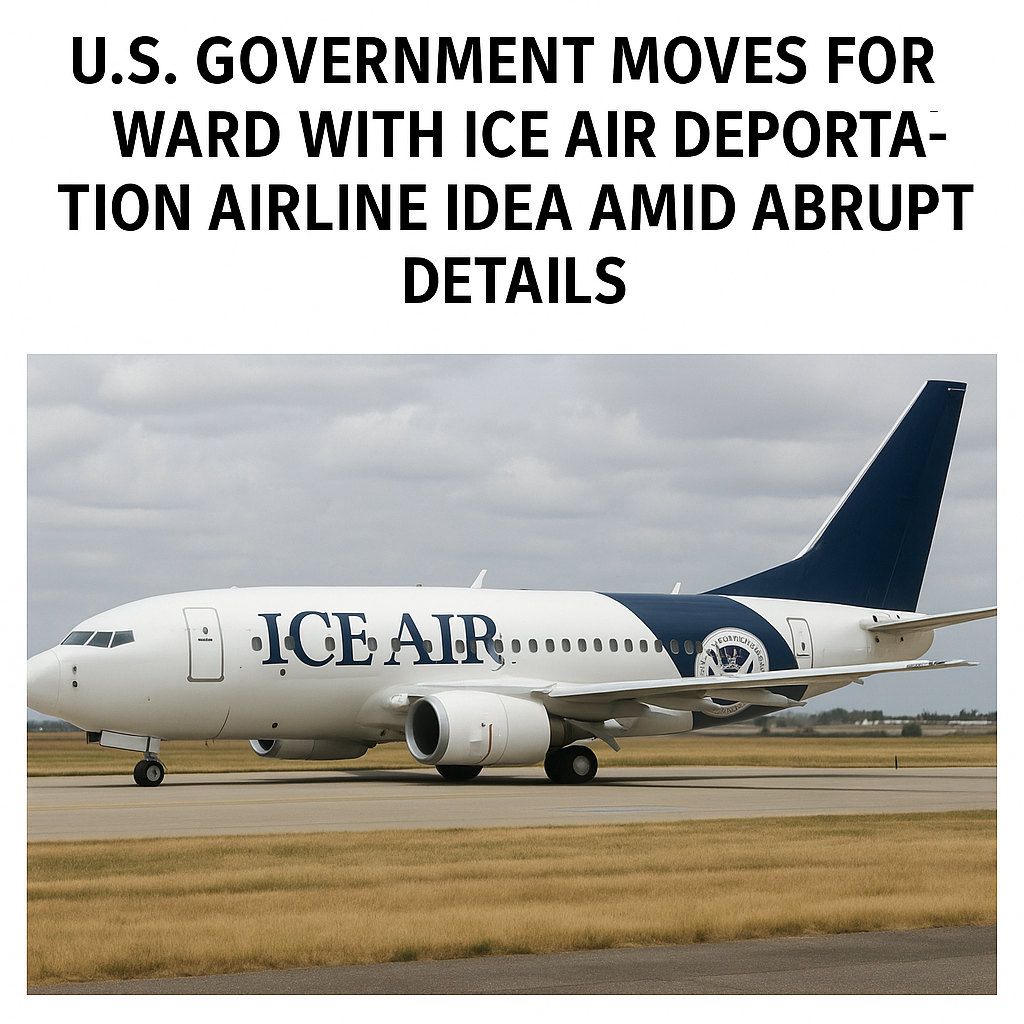
Donald Trump is making a return to the airline sector, this time adopting a distinctive strategy. While initial insights were provided last year, recent updates have clarified the project further, as a new request for proposals has been sent to aviation firms to assist with this endeavor.
ICE purchasing its own fleet of aircraft for deportations
Traditionally, the U.S. has relied on outside airlines for deportation flights, utilizing carriers such as Avelo Air, Eastern Air Express, GlobalX Air, Omni Air International, and World Atlantic Airlines. This setup has proven lucrative for these airlines, providing a reliable source of income.
The Trump administration seeks to substantially boost deportations, aiming for one million undocumented immigrants each year. During his first year, ICE deported roughly 400,000 undocumented persons.
To achieve these bold objectives, former Homeland Security Secretary Kristi Noem pushed for ICE to possess and run its own fleet of planes to double monthly deportation rates. By late 2025, this vision started to come to life with the Department of Homeland Security (DHS) acquiring six Boeing 737-700s for $140 million from Avelo, which later halted its deportation services.
Even with Noem’s resignation and the appointment of Markwayne Mullin, the “ICE Air” initiative continues to progress, with a rollout expected by July 2027. The fleet will comprise six Boeing 737-700s and two Gulfstream G650ERs (known as C-37Bs in government terminology) for deportations, emergency interventions, and high-risk charters.
At present, ICE rents 8-14 planes for deportations, enabling around 15,000 deportations every month. Owning aircraft will permit ICE to enhance deportations and alleviate overcrowding in detention centers.
The financial commitment for the aircraft is considerable, yet Trump’s funding proposal has raised ICE’s budget to over $75 billion, out of which $30 billion is allocated for deportations, an increase from the prior annual budget of $9.5 billion.
Deportation flights are estimated to cost around $25,000 per hour, covering the aircraft, crew, security, and medical staff, amounting to $100,000 to $200,000 per journey.
Is there a valid reason for the government to initiate this “airline?”
Disagreeing over Trump’s deportation policies is a matter of perspective, so let’s examine the aviation aspect. Is it more effective for the government to run its own “airline” or to outsource flights?
Initially, it appeared that the government would directly oversee the fleet, but DHS intends to engage contractors for flight operations, including crews, security, and medical personnel.
DHS asserts that this strategy will save taxpayers hundreds of millions, but the actual efficiency improvements are uncertain, as airlines are generally efficient, and government operations may hinder efficiency.
The notion that deportation activities are stymied by a lack of aircraft availability is surprising, since charter operators can quickly adjust capacity based on demand, unlike owning aircraft.
Furthermore, if immigration policies were to shift, decreasing the need for deportations, possessing planes could become less feasible.
This isn’t the first instance of a government “airline.” The Justice Prisoner and Alien Transportation System (JPATS) manages prisoner transport throughout the U.S., complete with a designated terminal at Oklahoma City Airport (OKC).
Conclusion
The Trump administration is progressing with its initiatives to centralize deportation flights by procuring aircraft to escalate deportations. Although the government currently leases aircraft, enhanced funding for ICE facilitates the operation of its own Boeing 737-700s and Gulfstream G650ERs.
The effectiveness of this method is debatable, as the government will continue to outsource operations. If aircraft availability is truly the concern, it is astonishing, considering the steady revenue for operators. Assertions of taxpayer savings require additional clarification.
What are your thoughts on the ICE Air initiative?