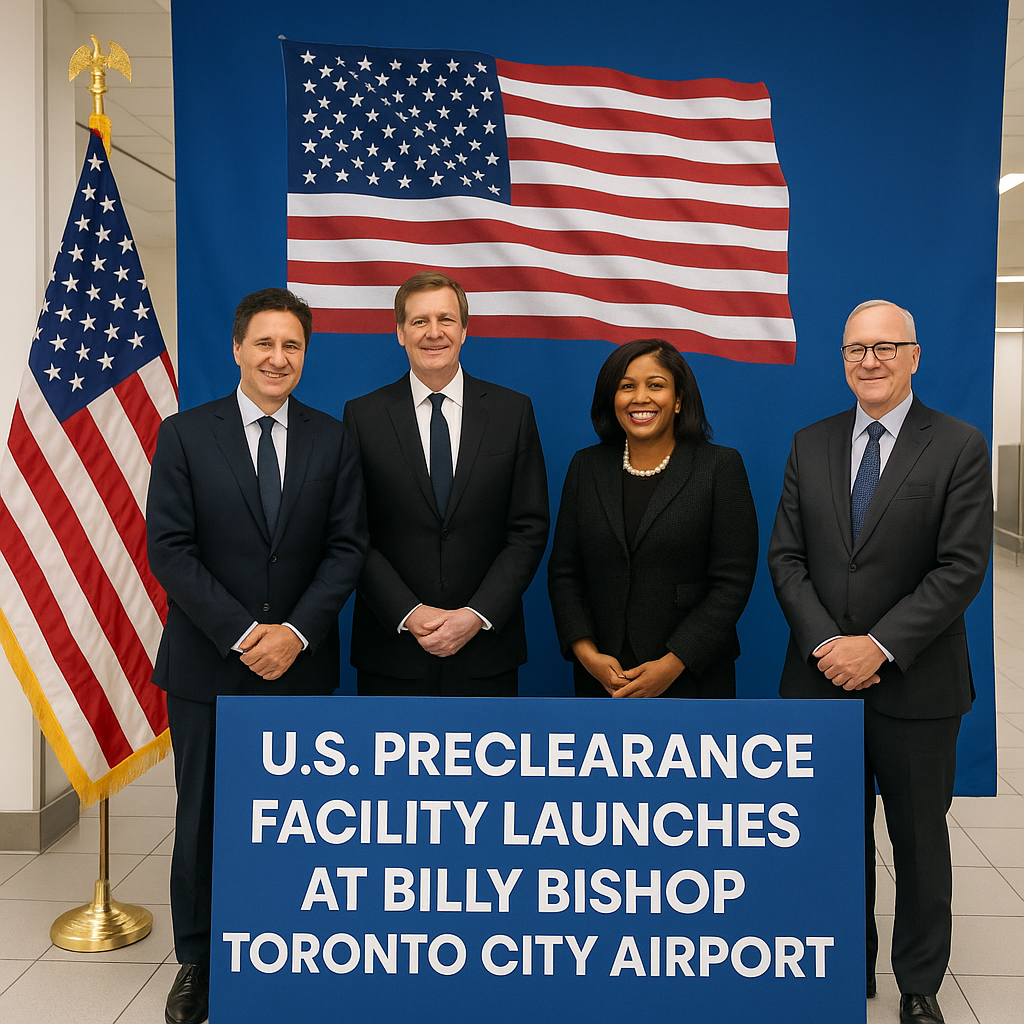
United States Customs & Border Protection (CBP) operates Preclearance facilities at designated foreign airports, allowing passengers to complete customs and immigration processes before boarding their flights to the US. The goal is to bolster security and provide a competitive edge for the airport.
In that context, numerous Canadian airports feature US Preclearance facilities. Today marks a significant development after more than ten years of efforts at one of Canada’s distinctive “city” airports.
Toronto City Airport secures US Preclearance
While Toronto Pearson International Airport (YYZ) serves as the primary international gateway in the Toronto region, there’s also Billy Bishop Toronto City Airport (YTZ), located much nearer to downtown and operating exclusively with turboprops.
Toronto City Airport focuses on convenience, assuring passengers that they need not arrive too early due to the airport’s smaller size. Now, the airport has an additional selling point — as of today (Tuesday, March 10, 2026), Toronto City Airport features a US Preclearance facility.
This has been a goal for the airport for over a decade, with the official project launching in 2023, constructed at a cost of $30 million CAD. It’s important to note that with these Preclearance facilities, the host country (Canada) bears the construction costs and some supportive functions, while the US supplies the CBP officers.
Officials anticipate that this new Preclearance facility could elevate the airport’s annual economic contribution from $2.1 billion CAD to $5.3 billion CAD, with potential increase in annual airport tax revenue from $150 million CAD to $215 million CAD (“could” being the operative term here).
Here’s how the Canadian government articulates the advantages of this arrangement:
Signifying a vital partnership with the United States Customs and Border Protection, the new preclearance facility will yield significant benefits to Canadians and the aviation sector by:
– Simplifying the travel process for U.S.-bound passengers, allowing them to finalize the customs process pre-departure and head straight to their connections or final destinations.
– Improving border security and early threat identification by facilitating collaboration between Canada and the United States in managing border risks and addressing common security issues.
– Promoting economic expansion and job creation through increased economic contributions by the airport in the region and enhancing employment on both sides of the border.
– Fortifying trade and tourism connections by making cross-border travel more accessible and boosting overall economic activity between Canada and the United States, while also opening new opportunities and destinations for Canadians traveling to the US and connections to other international locations.
It will be intriguing to observe how Toronto City Airport progresses
Historically, Porter Airlines has predominated at Toronto City Airport, though Air Canada has been increasingly establishing a presence, with both carriers operating De Havilland Dash 8s.
Porter has seamlessly managed transborder flights from Toronto City Airport (with U.S. immigration conducted upon arrival instead of departure), contrary to Air Canada, which hasn’t previously offered those routes.
Nevertheless, following the opening of the US Preclearance facility, Air Canada has revealed intentions to introduce four routes to the United States, including Boston (BOS), Chicago (ORD), New York (LGA), and Washington (IAD). Although Porter has already provided transborder flights, it is also expanding its own service network.
The prevailing belief is that the addition of a Preclearance facility will significantly boost the demand for airport usage, and based on the new routes being initiated, airlines appear to concur. My own perspective on Preclearance facilities is neutral, making it challenging to understand how this impacts decision-making. Additionally, the current climate may not be ideal for expanding flights between the two nations, given the strained relations.
Another point to consider is the ongoing discussions about extending the runway at Toronto City Airport to accommodate jets. This issue has divided the community, with some politicians asserting that it’s only a matter of time before jets receive approval, while others strive to prevent such development.
This topic has been under consideration for quite some time. For instance, back in 2013, Porter ordered 30 Bombardier CS100 aircraft (now branded as the Airbus A220-100). This order was contingent upon government decisions to permit jets at Toronto City Airport, which never materialized. Ultimately, the airline opted for Embraer E195-E2s instead, utilizing them to grow from other airports.
In conclusion
Toronto City Airport now hosts a US Preclearance facility, which both airport and city officials believe will transform demand. YTZ is a distinctive airport, given its closeness to the city, smaller airport size, and its exclusive turboprop operations during a time when jets dominate the aviation landscape.
It’ll be interesting to see